

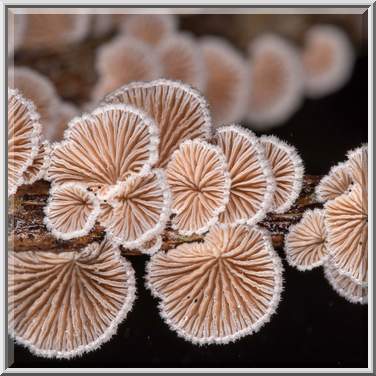
Black corticioid fungus Biscogniauxia on a tree on Caney Creek section of Lone Star Hiking Trail in Sam Houston National Forest near Huntsville. Texas


Album 2437: Lichens in Sam Houston Forest, Texas, January 26, 2019
This image presents an intriguing close-up view of a black corticioid fungus growing on a tree trunk. The fungus forms a thick, dark brown layer around the base of one of the tree's branches, with its color and texture contrasting strikingly against the lighter-colored bark. A greenish moss-like substance is visible on the left side of the image, partially covering the fungus. The overall appearance suggests that the fungus may be producing spores or other reproductive structures.
The image provides a detailed look at the intricate relationships between fungi and their host plants. Corticioid fungi are known for their ability to colonize dead wood, where they break down organic matter and recycle nutrients. By studying these organisms up close, researchers can gain valuable insights into their ecological roles and potential applications in various fields.
In summary, this image offers a fascinating glimpse into the world of mycology, highlighting the unique characteristics of black corticioid fungus as it interacts with its environment. Its striking appearance and intriguing behavior make it an attractive subject for further exploration and study. – AI vision
🇪🇸 Descripción en español / Spanish Description
El hongo corticioso negro Biscogniauxia en un árbol en la sección Caney Creek del Lone Star Hiking Trail en el bosque nacional Sam Houston cerca de Huntsville, Texas, 26 de enero de 2019. Esta imagen presenta una intrigante vista cercana de un hongo corticioso negro que crece en el tronco de un árbol. El hongo forma una capa espesa y marrón oscuro alrededor de la base de una de las ramas del árbol, con su color y textura contrastando notablemente contra la corteza de color más claro. Una sustancia verde parecida a musgo es visible en el lado izquierdo de la imagen, cubriendo parcialmente al hongo. El aspecto general sugiere que el hongo puede estar produciendo esporas u otras estructuras reproductivas. La imagen proporciona un detallado vistazo a las intrincadas relaciones entre los hongos y sus plantas anfitrionas. Los hongos corticiosos son conocidos por su capacidad de colonizar madera muerta, donde descomponen la materia orgánica y reciclan nutrientes. Estudiando estos organismos en detalle, los investigadores pueden obtener valiosos conocimientos sobre sus roles ecológicos y potenciales aplicaciones en diversas áreas. En resumen, esta imagen ofrece un fascinante vistazo al mundo de la micología, destacando las características únicas del hongo corticioso negro mientras interactúa con su entorno. Su aspecto impresionante y comportamiento intrigante lo convierte en un tema atractivo para explorar y estudiar. – Spanish translation


