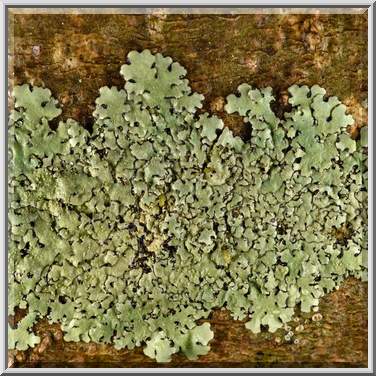

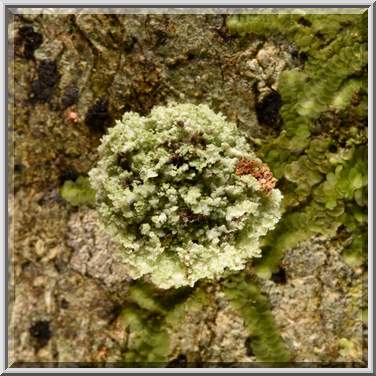
Medallion lichen (Dirinaria) on a tree in Big Creek Scenic Area of Sam Houston National Forest. Shepherd, Texas


Album 2440: Bryan - Sam Houston Forest, Texas, January 29 - February 1, 2019
The image presents a detailed view of a medallion lichen, specifically Dirinaria, growing on a tree within the Big Creek Scenic Area of Sam Houston National Forest in Texas. The photograph was taken on February 1, 2019.
**Key Features:**
* **Lichen Appearance:** The lichen exhibits a light green hue and features irregularly shaped lobes with wavy edges.
* **Texture and Color:** The surface is slightly raised and has a rough texture, with the color varying from light to dark green. Some areas display a yellowish tint due to lichen pigments.
* **Growth Pattern:** The lichen forms flat, overlapping rosettes that spread out from one another, resembling small medallions.
**Background:**
* **Tree Trunk:** The tree's brown bark serves as the background for the lichen growth. Various holes or cracks are visible in the trunk, which may be caused by insect damage or decay.
* **Scenic Area Context:** The photograph was captured within the Big Creek Scenic Area of Sam Houston National Forest, highlighting the natural environment where the medallion lichen is found.
**Overall Impression:**
The image provides a clear and detailed view of the medallion lichen growing on a tree in its natural habitat. The photograph showcases the unique characteristics of this species and highlights the importance of preserving and protecting these ecosystems. – AI vision
🇪🇸 Descripción en español / Spanish Description
El líquen en forma de medallón (Dirinaria) en un árbol del área escénica Big Creek de la Sam Houston National Forest. Shepherd, Texas, 1 de febrero de 2019. La imagen presenta una vista detallada de un líquen en forma de medallón, específicamente Dirinaria, creciendo en un árbol dentro del área escénica Big Creek de la Sam Houston National Forest en Texas. La fotografía fue tomada el 1 de febrero de 2019. **Características clave:** * **Apariencia del líquen:** El líquen presenta tonos verde claros y lóbulos de forma irregular con bordes ondulados. * **Textura y color:** La superficie tiene un relieve ligeramente elevado y una textura áspera, variando el color del verde claro al oscuro. Algunas áreas muestran un tinte amarillento debido a los pigmentos del líquen. * **Patrón de crecimiento:** El líquen forma rosetones planos y solapados que se extienden unos de otros, pareciéndose a pequeños medallones. **Antecedentes:** * **Tronco del árbol:** La corteza marrón del árbol sirve de fondo para el crecimiento del líquen. Se pueden ver diversos agujeros o grietas en la corteza, lo que puede ser causado por daño por insectos o podredumbre. * **Contexto del área escénica:** La fotografía fue capturada en el área escénica Big Creek de la Sam Houston National Forest, destacando el entorno natural donde se encuentra el líquen en forma de medallón. **Impresión general:** La imagen proporciona una vista clara y detallada del líquen en forma de medallón creciendo en un árbol en su hábitat natural. La fotografía muestra las características únicas de esta especie y destaca la importancia de preservar y proteger estos ecosistemas. – Spanish translation


