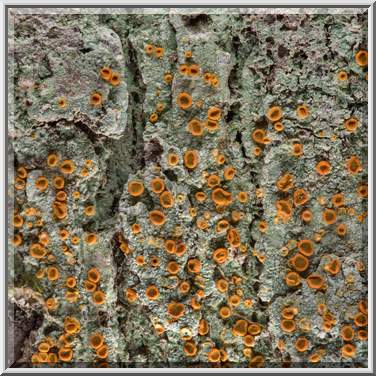
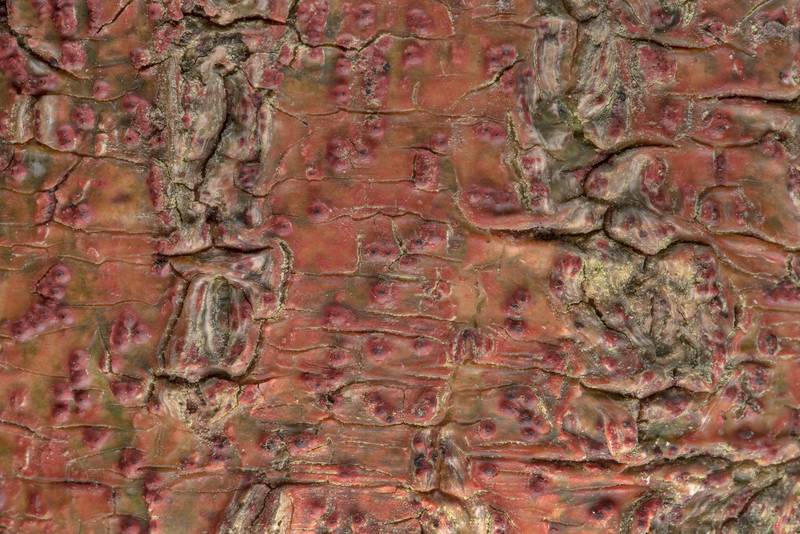

Bark rash lichen (Pyrenula cruenta) on tree bark in Big Creek Scenic Area of Sam Houston National Forest. Shepherd, Texas


Album 2443: Lichens in Sam Houston National Forest, Texas, February 1, 2019
The image shows a close-up view of a tree's bark, with numerous small red spots scattered across its surface. The bark appears to be reddish-brown and rough-textured, with deep grooves that run vertically along it.
**Key Features:**
* **Color:** The bark is primarily reddish-brown in color.
* **Texture:** The texture of the bark is rough, with deep grooves running vertically along its length.
* **Spots:** Small red spots are scattered across the surface of the bark. These spots appear to be circular or oval-shaped and range in size from about 1-5 mm in diameter.
**Lichen Identification:**
Based on the image, it is possible that the red spots on the bark are caused by a type of lichen called Pyrenula cruenta (bark rash lichen). Lichens are composite organisms consisting of fungi and algae or cyanobacteria living together in a symbiotic relationship. They often grow on tree trunks and branches, where they obtain moisture and nutrients.
**Conclusion:**
The image shows a close-up view of a tree's bark with numerous small red spots scattered across its surface. The rough texture and vertical grooves suggest that the bark is from an older tree. The presence of red spots could indicate the growth of Pyrenula cruenta lichen on the bark, but further examination or consultation with a botanist would be needed to confirm this identification. – AI vision
🇪🇸 Descripción en español / Spanish Description
El liquen de la corteza del árbol (Pyrenula cruenta) en el área escénica Big Creek de la selva nacional Sam Houston. Shepherd, Texas, 1 de febrero de 2019. La imagen muestra una vista detallada de la corteza de un árbol, con numerosas pequeñas manchas rojas dispersas por toda su superficie. La corteza parece ser de color marrón rojizo y con textura rugosa, con surcos profundos que corren verticalmente a lo largo de ella. **Características clave:** * **Color:** La corteza es principalmente de color marrón rojizo. * **Textura:** La textura de la corteza es áspera, con surcos profundos que corren verticalmente a lo largo de ella. * **Manchas:** Las pequeñas manchas rojas están dispersas por toda la superficie de la corteza. Estas manchas parecen ser circulares u ovaladas y tienen un tamaño que oscila entre aproximadamente 1-5 mm de diámetro. **Identificación del liquen:** Basándose en la imagen, es posible que las manchas rojas de la corteza estén causadas por un tipo de liquen llamado Pyrenula cruenta (lichen de erupción de la corteza). Los líquenes son organismos compuestos que consisten en hongos y algas o cianobacterias que viven juntos en una relación simbiótica. A menudo crecen en troncos y ramas de árboles, donde obtienen humedad y nutrientes. **Conclusión:** La imagen muestra una vista detallada de la corteza de un árbol con numerosas pequeñas manchas rojas dispersas por toda su superficie. La textura áspera y los surcos verticales sugieren que la corteza pertenece a un árbol más viejo. La presencia de manchas rojas podría indicar el crecimiento del liquen Pyrenula cruenta en la corteza, pero se necesitaría un examen o consulta adicional con un botánico para confirmar esta identificación. – Spanish translation


