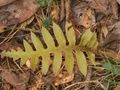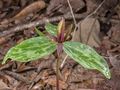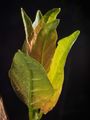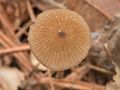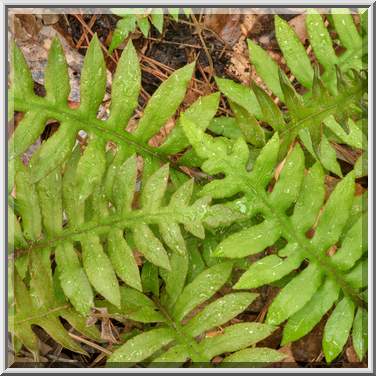
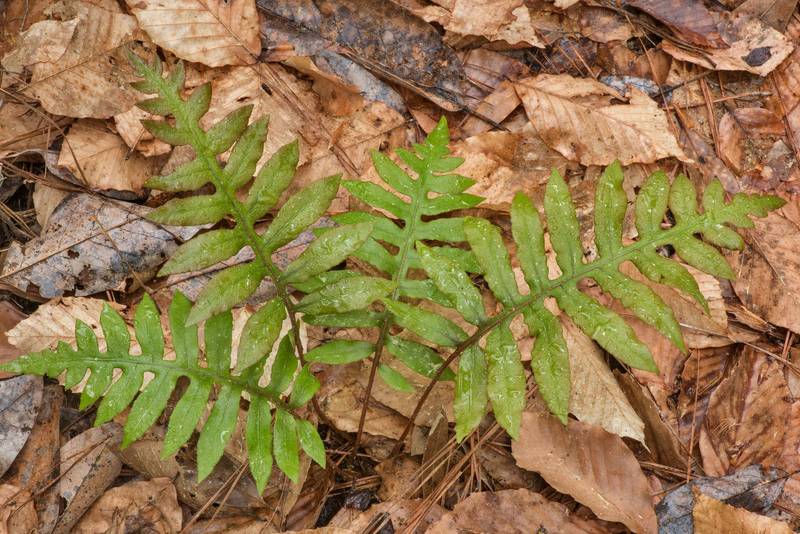
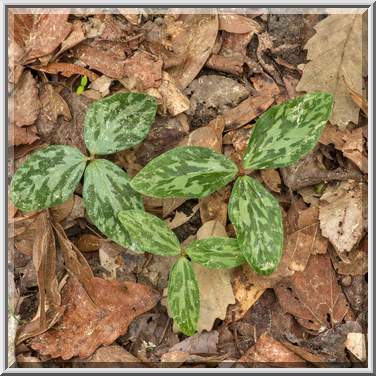
Emerging plant of netted chainfern (Woodwardia areolata) in Big Creek Scenic Area of Sam Houston National Forest. Shepherd, Texas


Album 2461: Sam Houston Forest, Coldspring, Texas, March 10, 2019
The image captures a close-up view of an emerging plant of **netted chainfern (Woodwardia areolata)** situated on the forest floor.
In the foreground, three bright-green fronds stand out amidst a bed of dry brown leaves and pine needles. The frond in the center is slightly larger than those to its left and right, with a slightly different shape that hints at its earlier stage of growth. This central frond appears more mature than the two others, which have yet to unfurl their full complement of leaflets.
The netted chainfern's distinctive features are evident: its broad, flat fronds and long petioles (stems). The leaves are divided into multiple segments, giving them a lacy appearance. These characteristics are typical of ferns in the genus **Woodwardia**, which includes several species found throughout North America.
The image was taken on March 10, 2019, at Big Creek Scenic Area within Sam Houston National Forest in Shepherd, Texas. The photographer likely captured the image during a spring or early summer visit to the forest, when plant growth is at its peak.
Overall, this image offers a detailed and intimate view of an emerging netted chainfern plant growing on the forest floor, highlighting its unique characteristics and habitat amidst a bed of dry leaves and pine needles. – AI vision
🇪🇸 Descripción en español / Spanish Description
La planta emergente de Woodwardia areolata en el área turística de Big Creek de la selva nacional Sam Houston. Shepherd, Texas, el 10 de marzo de 2019. La imagen muestra una vista cercana de una planta emergente de **Woodwardia areolata** situada en el suelo del bosque. En primer plano, sobresalen tres hojas verdes brillantes entre un lecho de hojas marrones secas y agujas de pino. La hoja central es ligeramente más grande que las de la izquierda y la derecha, con una forma ligeramente diferente que indica su etapa inicial de crecimiento. Esta hoja central parece más madura que las otras dos, que aún no han desplegado todo su complemento de hojuelas. Los rasgos distintivos del Woodwardia areolata son evidentes: sus hojas anchas y planas y largos peciolos (talones). Las hojas están divididas en múltiples segmentos, dándoles un aspecto lacónico. Estas características son típicas de las helechos del género **Woodwardia**, que incluye varias especies encontradas en toda América del Norte. La imagen fue tomada el 10 de marzo de 2019, en el área turística de Big Creek dentro del bosque nacional Sam Houston en Shepherd, Texas. El fotógrafo probablemente capturó la imagen durante una visita primaveral o temprana del bosque, cuando el crecimiento vegetal está en su punto máximo. En general, esta imagen ofrece una vista detallada e íntima de una planta emergente de Woodwardia areolata creciendo en el suelo del bosque, destacando sus características únicas y su hábitat entre un lecho de hojas secas y agujas de pino. – Spanish translation