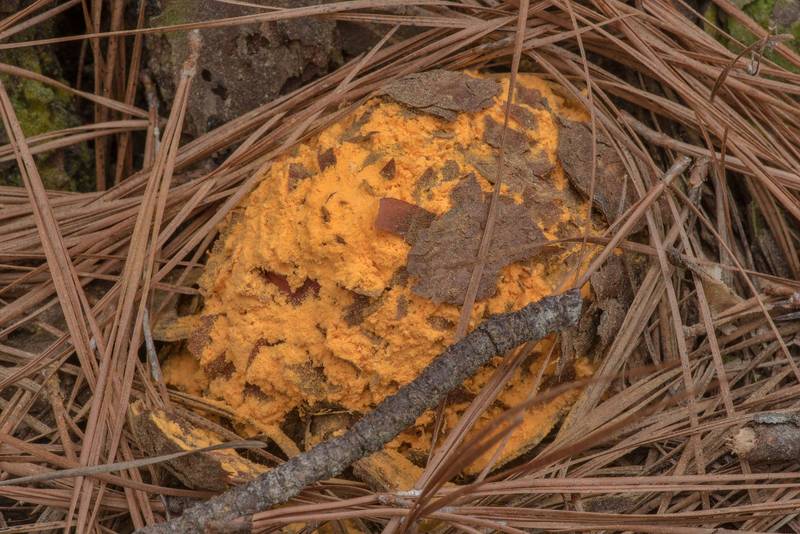
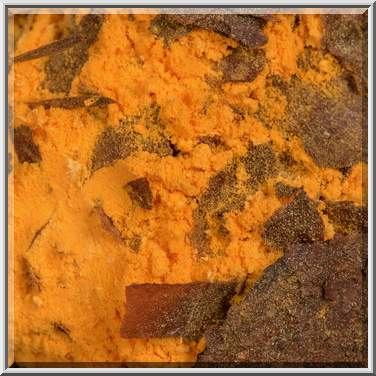
Pine-pine gall rust (Endocronartium harknessii, Cronartium harknessii rust fungus) on a swollen root at the base of a pine in Big Creek Scenic Area of Sam Houston National Forest. Shepherd, Texas


Album 2461: Sam Houston Forest, Coldspring, Texas, March 10, 2019
The image depicts a close-up view of a pine-pine gall rust (Endocronartium harknessii, Cronartium harknessii) on a swollen root at the base of a pine tree in Big Creek Scenic Area of Sam Houston National Forest.
* **Pine-Pine Gall Rust**
* The fungus is characterized by its bright orange color and gelatinous texture.
* It appears to be growing on top of a swollen root, which suggests that it has infected the plant.
* The rust fungus is likely causing damage to the pine tree by interfering with its ability to transport water and nutrients.
* **Swollen Root**
* The root is swollen due to the presence of the fungus, which has caused an increase in size and volume.
* The swelling may be a result of the fungus's growth and development within the plant tissue.
* The root appears to be covered with long, thin needles from the pine tree above it.
* **Pine Tree**
* The pine tree is visible in the background of the image, with its trunk and branches extending beyond the frame.
* The tree's needles are a light brown color, which suggests that they may have been affected by the rust fungus.
Overall, the image provides a detailed view of the pine-pine gall rust on a swollen root at the base of a pine tree. – AI vision
🇪🇸 Descripción en español / Spanish Description
El hongo de la roya de los pinos (Endocronartium harknessii, hongo de la roya Cronartium harknessii) en una raíz hinchada en la base de un pino en el área escénica del arroyo Big de la selva nacional Sam Houston. Shepherd, Texas, 10 de marzo de 2019. La imagen representa una vista detallada de la roya de los pinos (Endocronartium harknessii, Cronartium harknessii) en una raíz hinchada en la base de un árbol de pino en el área escénica del arroyo Big de la selva nacional Sam Houston. * **Roya de los Pinos** * El hongo se caracteriza por su color naranja brillante y textura gelatinosa. * Este parece estar creciendo encima de una raíz hinchada, lo que sugiere que ha infectado la planta. * El hongo de la roya probablemente está causando daño al árbol de pino al interferir con su capacidad para transportar agua y nutrientes. * **Raíz Hinchada** * La raíz está hinchada debido a la presencia del hongo, lo que ha provocado un aumento en el tamaño y volumen. * El hinchazón puede ser resultado del crecimiento y desarrollo del hongo dentro del tejido de la planta. * La raíz parece estar cubierta con agujas finas procedentes del árbol de pino situado encima. * **Árbol de Pinos** * El árbol de pinos es visible en el fondo de la imagen, extendiéndose su tronco y ramas más allá del marco. * Las agujas del árbol son de color marrón claro, lo que sugiere que pueden haber sido afectadas por el hongo de la roya. En general, la imagen proporciona una vista detallada de la roya de los pinos en una raíz hinchada en la base de un árbol de pino. – Spanish translation


