 |
| |||||||||||||||||

| ||||||||||||||||||


| Similar |   |
  |
  |
  |
  |
| |||||||||||||||||||||||||||||
| |||||||||||||||||||||||||||||
| 1996 1997 1998 1999 2000 2001 2002 2003 2004 2005 2006 2007 2008 2009 2010 2011 2012 2013 2014 2015 2016 2017 2018 2019 2020 2021 2022 2023 2024 2025 2026 | |||||||||||||||||||||||||||||
| New version Slide Show Most Popular Full List Statistics Technical Details Home Page | |||||||||||||||||||||||||||||
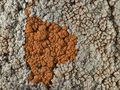
Aspicilia lichen, with its unique Squamulea squamosa (Caloplaca squamosa) growths, thrives on sandstone near Lost Pines Overlook in Bastrop State Park, Texas. The photograph was captured on March 14, 2019, showcasing the intricate patterns and textures of these fascinating organisms. – generated by AI |
The above photograph presents a close-up of two lichens growing side-by-side on a sandstone surface. The larger and lighter-colored lichen is Aspicilia(?) which features dark cracks that resemble tree bark. It grows on the left-hand side of the image, while Squamulea squamosa (Caloplaca squamosa) occupies the bottom right corner. The two lichens appear to be growing in a symbiotic manner, with the larger Aspicilia(?) providing shade and protection for the smaller Caloplaca squamosa. The sandstone surface is rough and uneven, with small cracks and crevices that provide habitat for both lichens. The overall appearance of the image suggests a natural and undisturbed environment, with the lichens thriving in their native habitat. In terms of color, the Aspicilia(?) has a light gray or beige hue, while the Caloplaca squamosa is slightly darker, with a reddish-brown tint. The sandstone surface provides a warm, earthy tone that complements the colors of the lichens. The image also highlights the intricate details of the lichens' growth patterns. Aspicilia(?) has a more irregular shape, with small cracks and fissures throughout its surface. Caloplaca squamosa, on the other hand, has a more uniform shape, with a series of rounded bumps or nodules along its length. Overall, the image provides a fascinating glimpse into the world of lichens and their unique adaptations to different environments. The combination of Aspicilia(?) and Caloplaca squamosa creates a striking visual effect, with their contrasting colors and textures adding depth and interest to the image. – AI vision |
Aspicilia (?) Líquen con Squamulea squamosa (Caloplaca squamosa) en arenisca cerca del mirador Lost Pines en el Parque Estatal de Bastrop, Texas, el 14 de marzo de 2019. La fotografía anterior presenta un primer plano de dos líquenes que crecen lado a lado en una superficie de arenisca. El líquen más grande y de color más claro es Aspicilia (?), que presenta grietas oscuras que recuerdan la corteza de un árbol. Crecen en el lado izquierdo de la imagen, mientras que Squamulea squamosa (Caloplaca squamosa) ocupa la esquina inferior derecha. Los dos líquenes parecen crecer de manera simbiótica, con la Aspicilia (?) más grande proporcionando sombra y protección para la Caloplaca squamosa más pequeña. La superficie de arenisca es áspera e irregular, con pequeñas grietas y hendiduras que proporcionan hábitat a ambos líquenes. El aspecto general de la imagen sugiere un entorno natural y no perturbado, con los líquenes prosperando en su hábitat nativo. En términos de color, la Aspicilia (?) tiene un tono gris claro o beige, mientras que la Caloplaca squamosa es ligeramente más oscura, con un matiz pardusco rojizo. La superficie arenisca proporciona un tono cálido y terroso que complementa los colores de los líquenes. La imagen también destaca los detalles intrincados de los patrones de crecimiento de los líquenes. Aspicilia (?) tiene una forma más irregular, con pequeñas grietas y fisuras en toda su superficie. La Caloplaca squamosa, por otro lado, tiene una forma más uniforme, con una serie de protuberancias o nódulos redondeados a lo largo de su longitud. En general, la imagen proporciona un fascinante vistazo al mundo de los líquenes y sus adaptaciones únicas a diferentes entornos. La combinación de Aspicilia (?) Y Caloplaca squamosa crea un efecto visual sorprendente, con sus colores contrastantes y texturas agregando profundidad e interés a la imagen. – Spanish translation |
| [+] | sandstone |
Keyword variants
high resolution online digital collection
Bastrop State Park photo capture
Lone Star State
United States
picture gallery
photo album
documentary photographs
daily pics
Bastrop SP
TX
travelogue
snapshots
sightseeing
photowalks
photoblog
graphic
fotografias
foto
America