
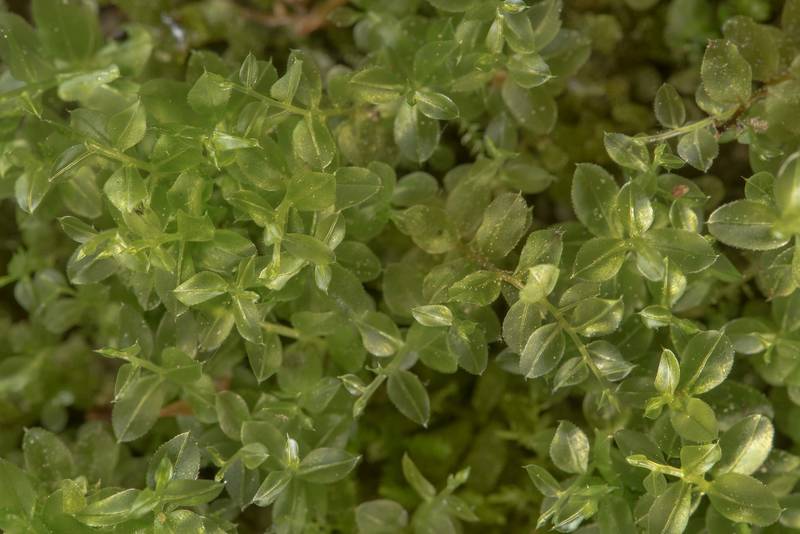

Many-fruited thyme-moss (Plagiomnium affine(?), Mniaceae or may be P. cuspidatum) on floodplain on Caney Creek Trail (Little Lake Creek Loop Trail) in Sam Houston National Forest near Huntsville. Texas


Album 2475: Sam Houston Forest, Texas, March 30, 2019
The image features a close-up view of multiple small green plants with tiny leaves and stems, resembling moss or thyme due to their diminutive size and leaf structure.
**Key Features:**
* The plants have oval-shaped leaves that are slightly pointed at the tip.
* They grow in dense clusters, forming a thick mat on the ground.
* A few scattered brownish-red filaments can be seen among the greenery, likely representing spores or reproductive structures.
**Background and Context:**
* The plants appear to be growing in a forested area, possibly on a tree trunk or rock surface.
* They are surrounded by other vegetation, including trees and shrubs.
* Based on the caption, it is likely that the image was taken in a natural setting, such as a national forest.
**Inferences:**
* Given the dense growth pattern and small size of the plants, they may be epiphytes or lithophytes that grow on other plants or rocks rather than in soil.
* The presence of spores suggests that these plants are capable of reproducing vegetatively, which is common among mosses and liverworts. – AI vision
🇪🇸 Descripción en español / Spanish Description
Muchos musgos frutales (Plagiomnium affine(?), Mniaceae o quizás P. cuspidatum) en llanuras de inundación en el Sendero Caney Creek (Sendero Little Lake Creek Loop) en el Bosque Nacional Sam Houston cerca de Huntsville, Texas, 30 de marzo de 2019. La imagen muestra una vista detallada de múltiples pequeñas plantas verdes con hojas y tallos diminutos, parecidos a musgo o tomillo debido a su tamaño reducido y estructura foliar. **Características clave:** * Las plantas tienen hojas de forma ovalada que están ligeramente puntiagudas en la punta. * Crecen en grupos densos, formando una espesa capa sobre el suelo. * Entre la vegetación se pueden ver algunos filamentos parduzcos entre los árboles, que probablemente representan esporas o estructuras reproductivas. **Antecedentes y contexto:** * Las plantas parecen crecer en una zona forestal, posiblemente en el tronco de un árbol o superficie rocosa. * Están rodeadas de otra vegetación, incluyendo árboles y arbustos. * Según la descripción, es probable que la imagen se haya tomado en un entorno natural, como un bosque nacional. **Inferencias:** * Dado el patrón de crecimiento denso y el pequeño tamaño de las plantas, pueden ser epífitas o litófitas que crecen en otras plantas o rocas en lugar de en suelo. * La presencia de esporas sugiere que estas plantas son capaces de reproducirse vegetativamente, lo que es común entre musgos y hígados. – Spanish translation


