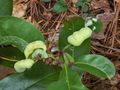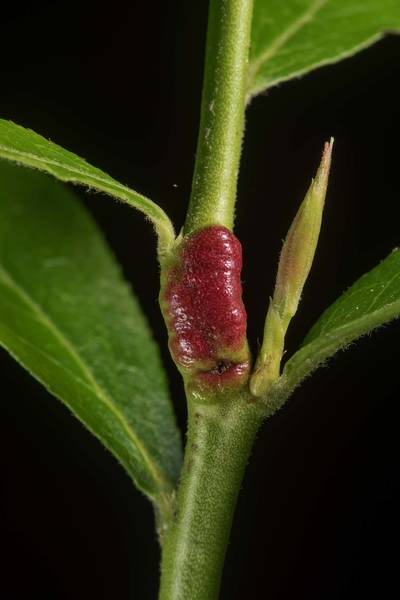

Insect gall on a shoot of blackberry in Big Creek Scenic Area of Sam Houston National Forest. Shepherd, Texas


Album 2484: Big Creek Scenic Area of Sam Houston National Forest. Shepherd, Texas, April 20, 2019
The image displays an insect gall located on the stem of a blackberry plant. The gall is red and appears to be soft. It seems to be formed by an insect such as a wasp or fly that has laid its eggs inside it and then fed off the plant's nutrients, causing the growth of this abnormality.
The green shoot has two leaves growing from it, one on either side of the gall, and a small bud at the top of the image. The background is black, suggesting that the photo was taken in low light or against a dark surface. Overall, the image provides a detailed view of an insect gall on a blackberry plant, highlighting its unique appearance and growth pattern.
* **Insect Gall**:
* A red, soft-looking abnormality formed by an insect laying eggs inside it and feeding off the plant's nutrients.
* The insect is likely a wasp or fly that has caused the growth of this gall on the blackberry stem.
* **Shoot**:
* A green shoot with two leaves growing from it, one on either side of the gall.
* Has a small bud at the top of the image, indicating potential new growth.
* **Background**:
* The background is black, suggesting that the photo was taken in low light or against a dark surface. – AI vision
🇪🇸 Descripción en español / Spanish Description
Traduzca el siguiente texto del inglés al español:
Una agallas de insectos en un brote de zarzamora en Big Creek Scenic Area of Sam Houston National Forest. Shepherd, Texas, 20 de abril de 2019. La imagen muestra una agallas de insecto ubicada en el tallo de una planta de zarzamora. La agallas es roja y parece suave. Parece estar formada por un insecto como una avispa o mosca que ha puesto sus huevos dentro y luego se ha alimentado de los nutrientes de la planta, causando el crecimiento de esta anomalía. El brote verde tiene dos hojas creciendo desde él, una a cada lado de la agallas, y un pequeño brote en la parte superior de la imagen. El fondo es negro, lo que sugiere que la foto fue tomada con poca luz o contra una superficie oscura. En general, la imagen proporciona una vista detallada de una agallas de insectos en una planta de zarzamora, destacando su apariencia única y el patrón de crecimiento. * **Agallas de Insectos**: * Una agallas roja, suave al tacto, formada por un insecto que pone sus huevos dentro y se alimenta de los nutrientes de la planta. * El insecto es probablemente una avispa o mosca que ha causado el crecimiento de esta agallas en el tallo de zarzamora. * **Brote**: * Un brote verde con dos hojas creciendo desde él, una a cada lado de la agallas. * Tiene un pequeño brote en la parte superior de la imagen, lo que indica potencial nuevo crecimiento. * **Fondo**: * El fondo es negro, lo que sugiere que la foto fue tomada con poca luz o contra una superficie oscura. – Spanish translation