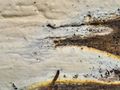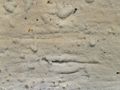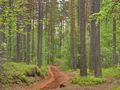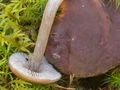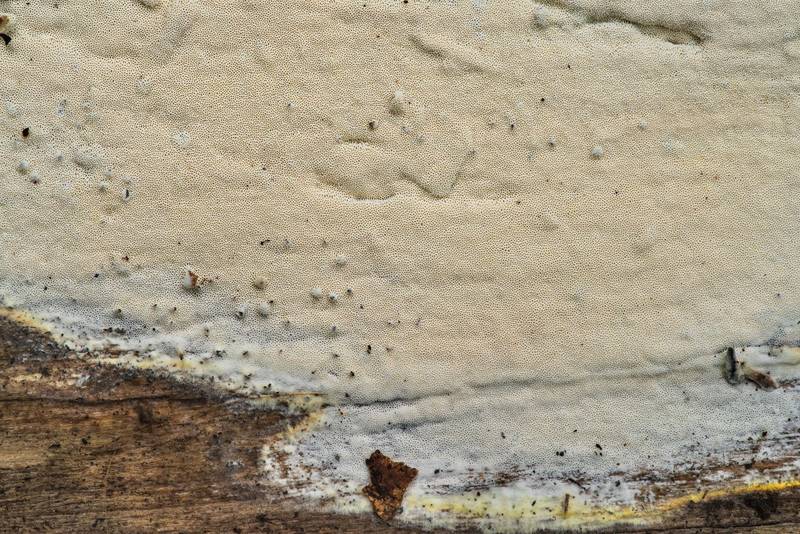

White porouse mushroom on a pine(?) log in Petiayarvi, north from St.Petersburg. Russia

Album 2513: Petiayarvi - Saint Petersburg, Russia, May 26 - 27, 2019
The image presents a detailed view of a white, porous substance growing on the surface of a pine log. The log's texture and color are clearly visible, with the white growth covering most of its surface. The growth appears to be irregularly shaped, with some areas featuring more prominent outgrowths than others.
**Key Features:**
* **Growth Pattern:** The growth pattern suggests that the substance is likely a type of fungus or lichen, which often grow in clusters or patches on tree bark.
* **Texture and Color:** The texture of the growth is rough and porous, while its color is a uniform white. This could indicate that the substance is composed of microscopic fungal hyphae or other microorganisms that are responsible for its growth.
* **Log Characteristics:** The pine log appears to be weathered and worn, with visible cracks and grooves on its surface. This suggests that the log has been exposed to the elements for some time, providing an ideal environment for the growth of fungi and other microorganisms.
**Conclusion:**
Based on the image, it is likely that the white, porous substance growing on the pine log is a type of fungus or lichen. The growth pattern, texture, and color all support this conclusion, and the weathered condition of the log provides an ideal environment for such organisms to thrive. – AI vision
🇷🇺 Описание по-русски / Russian Description
Белый пористой гриб на сосновым (?) бревне в Петиярви, к северу от Санкт-Петербурга. Россия, 26 мая 2019 года. На изображении представлен детальный вид белого пористой субстанции, растущей на поверхности соснового бревна. Текстура и цвет бревна хорошо видны, а пористая структура покрывает большую часть его поверхности. Пористый рост выглядит нерегулярной формы, при этом некоторые области имеют более заметные наросты, чем другие. **Основные особенности:** * **Схема роста:** Схема роста предполагает, что субстанция, вероятно, представляет собой разновидность гриба или лишайника, который часто растет скоплениями или пятнами на коре деревьев. * **Текстура и цвет:** Текстура роста грубая и пористоя, в то время как его цвет является однородным белым. Это может указывать на то, что субстанция состоит из микроскопических грибных гиф или других микроорганизмов, отвечающих за ее рост. * **Характеристики бревна:** Сосновый брусок выглядит потрепанным и потёртым, на его поверхности хорошо видны трещины и вмятины. Это указывает на то, что брусок находился под воздействием элементов в течение некоторого времени, создавая оптимальную среду для роста грибов и других микроорганизмов. **Заключение:** Исходя из изображения, можно предположить, что белый пористый нарост на сосновом бревне является разновидностью гриба или лишайника. Схема роста, текстура и цвет подтверждают этот вывод, а изношенное состояние бруска создает оптимальную среду для таких организмов. – Russian translation