
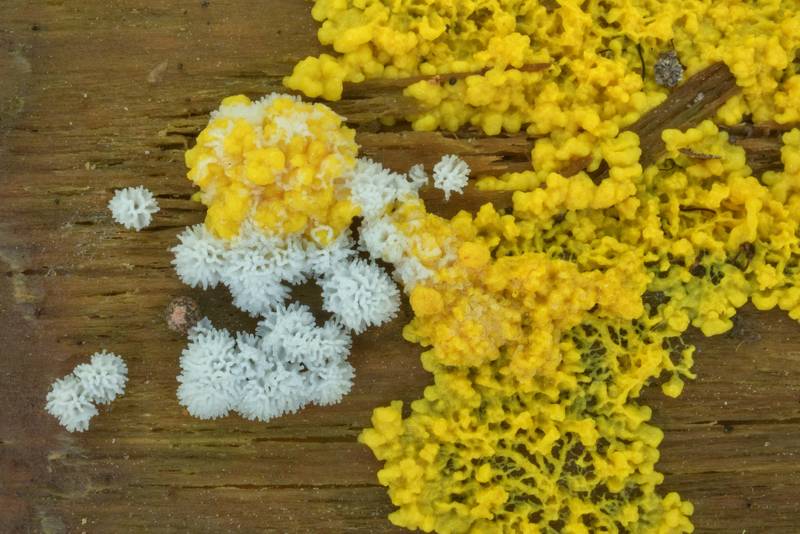

Gradually inflating slime mold Physarum polycephalum(?) (yellow) enveloping Ceratiomyxa fruticulosa var. porioides on a pine log on Caney Creek Trail (Little Lake Creek Loop Trail) in Sam Houston National Forest north from Montgomery. Texas


Album 2551: College Station - Sam Houston Forest, Texas, July 10 - 13, 2019
The image presents a captivating scene of two distinct fungi species interacting with each other and their environment on a pine log. The yellow slime mold appears to be gradually enveloping the white Ceratiomyxa fruticulosa var. porioides.
Upon closer inspection, it becomes evident that the yellow slime mold is actually a different species altogether: Physarum polycephalum. This can be deduced from the image's description of the interaction between Physarum and Ceratiomyxa, as well as the fact that both fungi are present in Texas during the summer months.
The image showcases an intricate relationship between these two organisms, with Physarum gradually enveloping Ceratiomyxa on the pine log. This process likely involves a complex interplay of chemical signals and cellular interactions, allowing Physarum to extend its mycelium over Ceratiomyxa while digesting it at the same time.
The presence of both species in Texas during July suggests that they are well-suited to the local climate and ecosystem conditions. The image also highlights the diversity of fungi present in this region, with multiple species coexisting on a single substrate.
Overall, this image provides valuable insights into the fascinating world of mycology, showcasing the complex relationships between different fungal species and their environments. – AI vision
🇪🇸 Descripción en español / Spanish Description
El moho de gelificación gradual Physarum polycephalum (?) (amarillo) rodeando a Ceratiomyxa fruticulosa var. porioides en un tronco de pino en el Caney Creek Trail (Little Lake Creek Loop Trail) en el Bosque Nacional Sam Houston al norte de Montgomery, Texas, el 13 de julio de 2019. La imagen presenta una escena cautivadora de dos especies de hongos distintas interaccionando entre sí y con su entorno en un tronco de pino. El moho amarillo parece rodear gradualmente al Ceratiomyxa fruticulosa var. porioides blanco. Al inspeccionarlo más detenidamente, se vuelve evidente que el moho amarillo es en realidad una especie completamente diferente: Physarum polycephalum. Esto puede deducirse de la descripción de la interacción entre Physarum y Ceratiomyxa, así como del hecho de que ambos hongos están presentes en Texas durante los meses de verano. La imagen muestra una relación compleja entre estos dos organismos, con Physarum rodeando gradualmente a Ceratiomyxa en el tronco de pino. Este proceso probablemente implica una interacción compleja de señales químicas e interacciones celulares, lo que permite a Physarum extender su micelio sobre Ceratiomyxa al mismo tiempo que la digiere. La presencia de ambas especies en Texas durante julio sugiere que están adaptadas bien al clima y las condiciones del ecosistema local. La imagen también destaca la diversidad de hongos presentes en esta región, con múltiples especies coexistiendo en un único sustrato. En general, esta imagen proporciona valiosas ideas sobre el fascinante mundo de la micología, mostrando las complejas relaciones entre diferentes especies de hongos y sus entornos. – Spanish translation


