
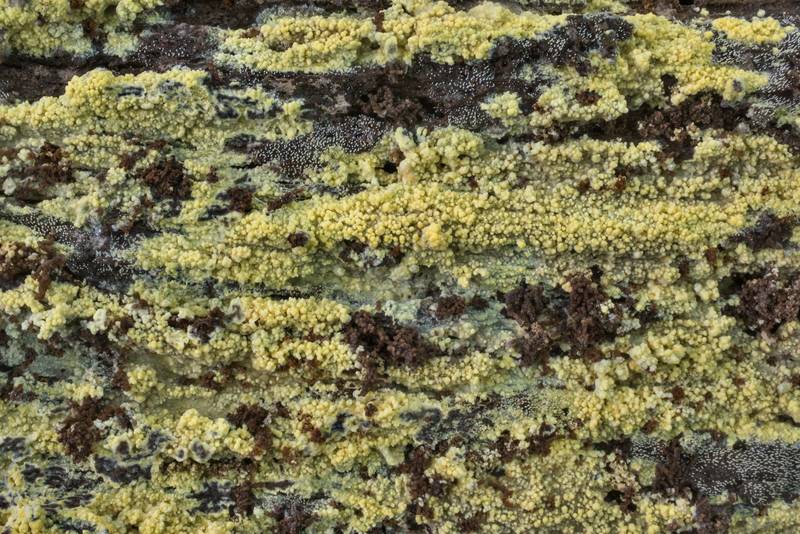
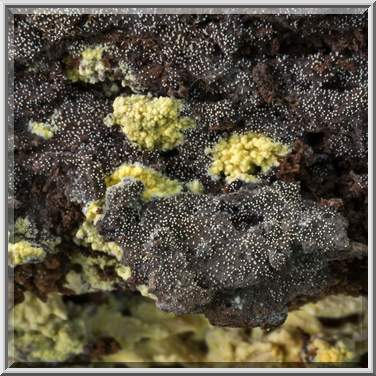
Yellow corticioid fungus together with Hydnoid (tooth) fungus Mycoacia(?) on rotting wood on Caney Creek Trail (Little Lake Creek Loop Trail) in Sam Houston National Forest north from Montgomery. Texas


Album 2551: College Station - Sam Houston Forest, Texas, July 10 - 13, 2019
The image depicts a close-up view of a section of decaying tree bark, showcasing various types of fungi and lichens growing on its surface. The dominant feature is a bright yellow corticioid fungus, characterized by its flat, crust-like appearance and irregularly shaped growths that resemble small clusters or tufts. This fungus is likely responsible for breaking down the wood as it decomposes.
In addition to the yellow fungus, other organisms are visible in the image. Brownish-red hyphal structures resembling a tooth-like fungus are present throughout the section of bark, indicating the presence of multiple species of fungi colonizing the decaying tree. Lichens may also be contributing to decomposition and nutrient cycling on the surface.
The texture of the bark is rough and irregular, with small cracks and crevices providing habitat for these microorganisms. The overall appearance suggests a dynamic ecosystem where different species are interacting and influencing one another's growth and survival.
The image provides valuable insights into the complex relationships between fungi, lichens, and decaying plant material in natural environments. It highlights the importance of these organisms in decomposing organic matter and recycling nutrients back into the soil, ultimately contributing to the health and diversity of ecosystems. – AI vision
🇪🇸 Descripción en español / Spanish Description
Un hongo corticiodo amarillo junto con un hongo (diente) de Hydnum Mycoacia(?) en madera podrida del camino Caney Creek (camino Little Lake Creek Loop) en el bosque nacional Sam Houston al norte de Montgomery. Texas, 13 de julio de 2019. La imagen muestra una vista cercana de una sección de corteza de árbol en descomposición que presenta varios tipos de hongos y líquenes creciendo en su superficie. El rasgo dominante es un hongo corticiodo amarillo brillante, caracterizado por su aspecto plano y similar a una costra y crecimientos con forma irregular que se asemejan a pequeños racimos o mechones. Este hongo probablemente sea el responsable de descomponer la madera mientras se descompone. Además del hongo amarillo, otros organismos son visibles en la imagen. Hay estructuras hifales pardusco-rojizas similares a un hongo dentado presentes por toda la sección de corteza, lo que indica la presencia de múltiples especies de hongos colonizando el árbol en descomposición. También puede ser que los líquenes contribuyan a la descomposición y al ciclo de nutrientes en la superficie. La textura de la corteza es rugosa e irregular, con pequeñas grietas y hendiduras que proporcionan un hábitat para estos microorganismos. El aspecto general sugiere un ecosistema dinámico en el que diferentes especies interactúan y afectan el crecimiento y la supervivencia de las otras. La imagen ofrece información valiosa sobre las complejas relaciones entre hongos, líquenes y materia vegetal en descomposición en entornos naturales. Destaca la importancia de estos organismos en la descomposición de la materia orgánica y el reciclaje de nutrientes al suelo, contribuyendo finalmente a la salud y diversidad de los ecosistemas. – Spanish translation


