
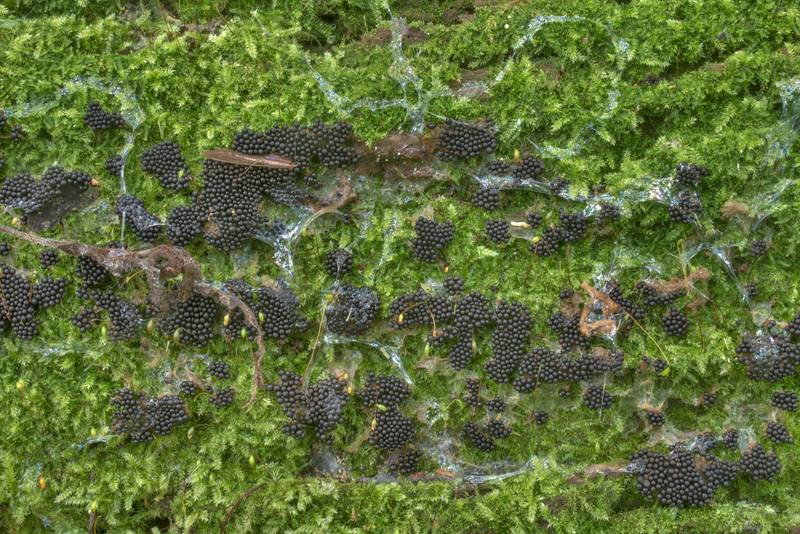
Lead shot slime mold (Cribraria argillacea)(?) on a mossy pine log on Caney Creek section of Lone Star Hiking Trail in Sam Houston National Forest north from Montgomery. Texas


Album 2554: Sam Houston Forest, Texas, July 20, 2019
The image presents a close-up view of a mossy pine log, with numerous small black or dark brown round fruiting bodies scattered across its surface. These fruiting bodies likely belong to a type of slime mold, which is a diverse group of organisms that feed on decaying organic matter and are commonly found in damp environments.
The presence of the fruiting bodies suggests that the image was taken during the reproductive stage of this particular species, as they form these structures to disperse their spores. The mossy pine log provides a suitable habitat for this organism, offering sheltered areas where it can feed and reproduce.
Given the location described in the caption - Sam Houston National Forest north from Montgomery, Texas - it is possible that this image was captured during a hike or nature walk through the forest. The fact that the image was taken on July 20th implies that the photographer may have been interested in documenting the various organisms present in the area at that time of year.
Overall, the image provides valuable information about the diversity of life found in this specific ecosystem and highlights the importance of preserving these natural habitats for future generations. – AI vision
🇪🇸 Descripción en español / Spanish Description
Moco del hongo esponja (Cribraria argillacea)(?) en un tronco de pino cubierto de musgo en la sección de Caney Creek del Sendero Lone Star Hiking en el Bosque Nacional Sam Houston al norte de Montgomery. Texas, 20 de julio de 2019. La imagen muestra una vista cercana de un tronco de pino cubierto de musgo, con numerosas pequeñas esporas negras u oscuras dispersas por toda su superficie. Estas esporas probablemente pertenecen a un tipo de hongo esponja, que es un grupo diverso de organismos que se alimentan de materia orgánica en descomposición y son comunes en entornos húmedos. La presencia de las esporas sugiere que la imagen fue tomada durante la etapa reproductiva de esta especie particular, ya que forman estas estructuras para dispersar sus esporas. El tronco de pino cubierto de musgo proporciona un hábitat adecuado para este organismo, ofreciendo áreas protegidas donde puede alimentarse y reproducirse. Dada la ubicación descrita en el título - Bosque Nacional Sam Houston al norte de Montgomery, Texas - es posible que esta imagen haya sido capturada durante una caminata o paseo por la naturaleza a través del bosque. El hecho de que se tomara la imagen el 20 de julio sugiere que el fotógrafo podría haber estado interesado en documentar los diversos organismos presentes en el área en ese momento del año. En general, la imagen proporciona información valiosa sobre la diversidad de vida encontrada en este ecosistema específico y destaca la importancia de preservar estos hábitats naturales para las generaciones futuras. – Spanish translation


