
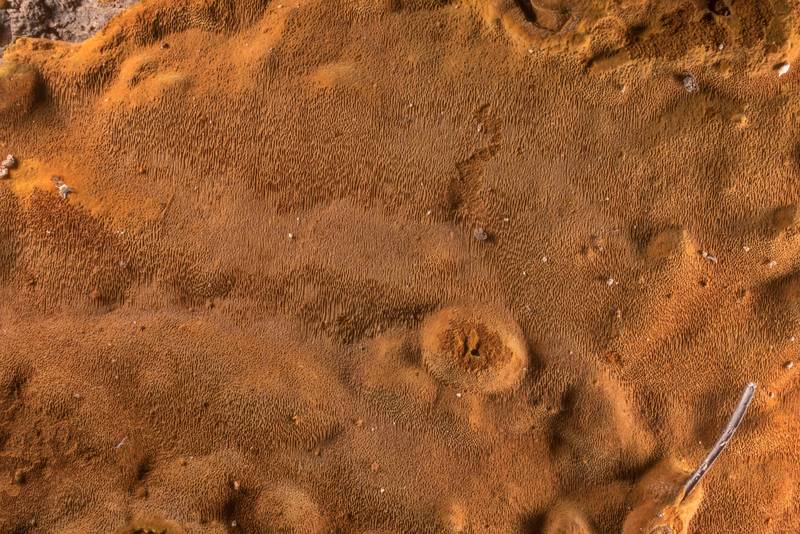

Some brown resupinate polypore mushroom on rotting wood on Caney Creek Trail (Little Lake Creek Loop Trail) in Sam Houston National Forest north from Montgomery. Texas


Album 2562: Sam Houston Forest - College Station, Texas, August 31 - September 6, 2019
The image showcases a close-up view of a brown resupinate polypore mushroom growing on rotting wood along Caney Creek Trail in Sam Houston National Forest, north of Montgomery, Texas.
In the top-left corner, small bits of light-colored bark are visible at the edge of the tree trunk. The resupinate polypore is characterized by its flat, fan-shaped or wavy growth pattern, covering a substantial portion of the wood surface with a dense layer of tiny, interwoven hairs that give it a soft and velvety texture.
The overall appearance of the mushroom suggests that it has been growing on this tree trunk for some time. The surrounding environment is not visible in the image, but based on the context provided by the caption, we can infer that the image was taken during late summer or early fall when the forest floor would be teeming with life.
The resupinate polypore mushroom's brown coloration may be due to its age and the natural process of decomposition, as it has likely been growing on this tree trunk for several years. The presence of rotting wood in the environment suggests that the area is prone to decay and fungal growth.
Overall, the image provides a detailed look at the unique characteristics of a resupinate polypore mushroom, highlighting its distinctive growth pattern, texture, and coloration. – AI vision
🇪🇸 Descripción en español / Spanish Description
Algunos hongos póliporos resupinados marrones sobre madera podrida en el Caney Creek Trail (Little Lake Creek Loop Trail) en Sam Houston National Forest al norte de Montgomery. Texas, agosto de 2019. La imagen muestra una vista detallada de un hongo póliporo resupinado marron creciendo sobre la madera podrida a lo largo del Caney Creek Trail en el Sam Houston National Forest, al norte de Montgomery, Texas. En la esquina superior izquierda, son visibles pequeños trozos de corteza clara en el borde del tronco de árbol. El hongo póliporo resupinado se caracteriza por su modelo de crecimiento plano, en forma de abanico o ondulante, cubriendo una parte sustancial de la superficie de la madera con una densa capa de pequeños pelos entrelazados que le dan un aspecto suave y veloso. La apariencia global del hongo sugiere que ha estado creciendo sobre este tronco de árbol durante algún tiempo. El entorno circundante no es visible en la imagen, pero basándose en el contexto proporcionado por el subtítulo, podemos inferir que la imagen fue tomada a finales del verano o principios del otoño cuando el suelo forestal estará repleto de vida. La coloración marron del hongo póliporo puede ser debida a su edad y al proceso natural de descomposición, ya que ha estado creciendo sobre este tronco de árbol durante varios años. La presencia de madera podrida en el entorno sugiere que la zona es propensa a la putrefacción y al crecimiento fúngico. En general, la imagen proporciona un detallado análisis de las características únicas del hongo póliporo resupinado, destacando su modelo de crecimiento distintivo, textura y coloración. – Spanish translation


