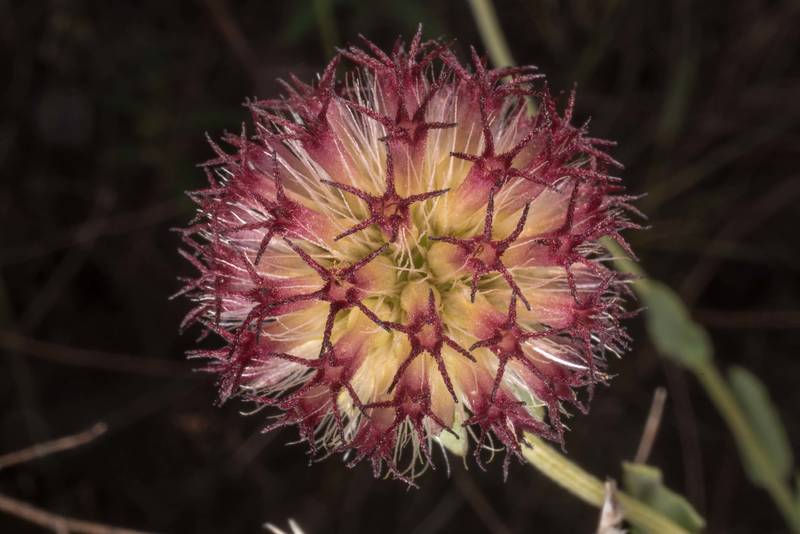

Spherical fruit head of Prairie gaillardia (Gaillardia aestivalis) with achenes in Bastrop State Park. Bastrop, Texas


Album 2577: Flowers in Bastrop Park, Texas, October 13, 2019
The image presents a close-up view of a spherical flower head or fruit, showcasing its intricate details. The flower is characterized by its light yellow center and pinkish-purple outer petals, which are densely packed around the central core. The outermost layer of the flower features long, thin, and pointed protrusions that resemble hairs or bristles.
Upon closer inspection, it becomes apparent that these protrusions are actually achenes, which are dry fruits that develop from individual flowers in an inflorescence. This suggests that the image is not solely depicting a single flower but rather a collection of smaller flowers clustered together to form the fruit head.
The background of the image appears dark and blurry, with indistinct shapes visible in the periphery. The overall atmosphere of the photograph implies that it was taken outdoors, possibly during the daytime or early evening when natural light is abundant. The presence of achenes on the flower head indicates that the plant has reached maturity and is ready to disperse its seeds.
In summary, the image provides a detailed view of a spherical fruit head or flower cluster featuring long, thin protrusions that are actually achenes, set against a dark and blurry background that suggests an outdoor setting. – AI vision
🇪🇸 Descripción en español / Spanish Description
El cabezal esférico de la gaillardia de pradera (Gaillardia aestivalis) con aquenios en el Parque Estatal de Bastrop. Bastrop, Texas, 13 de octubre de 2019. La imagen presenta una vista detallada de un cabezal floral o fruto esférico, que muestra sus detalles intrincados. La flor se caracteriza por su centro amarillo claro y pétalos exteriores morado rojizo, que están densamente empaquetados alrededor del núcleo central. La capa más externa de la flor presenta protuberancias largas, delgadas y puntiagudas que se asemejan a pelos o cerdas. Tras un examen más detallado, resulta evidente que estas protuberancias son realmente aquenios, que son frutos secos que se desarrollan a partir de flores individuales en una inflorescencia. Esto sugiere que la imagen no ilustra únicamente una sola flor, sino más bien un conjunto de pequeñas flores agrupadas para formar el cabezal del fruto. El fondo de la imagen aparece oscuro y borroso, con formas indistintas visibles en la periferia. La atmósfera general de la fotografía sugiere que se tomó al aire libre, posiblemente durante el día o a primera hora de la tarde cuando la luz natural es abundante. La presencia de aquenios en el cabezal del fruto indica que la planta ha alcanzado la madurez y está lista para dispersar sus semillas. En resumen, la imagen proporciona una vista detallada de un cabezal de fruta esférico o racimo de flores con protuberancias largas y delgadas que son realmente aquenios, frente a un fondo oscuro y borroso que sugiere un entorno al aire libre. – Spanish translation