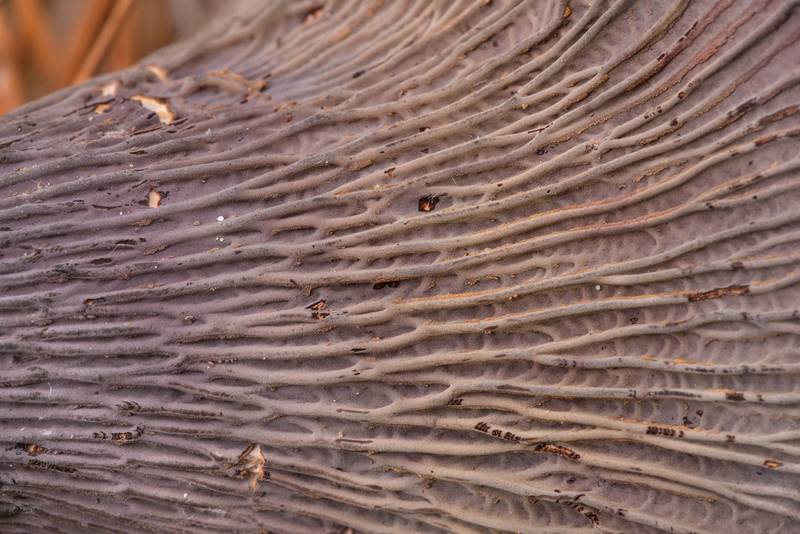

Close up of mushroom Gomphus ludovicianus collected in a Jasper farm and shown at Mushroom Walk in Watson Rare Native Plant Preserve. Warren, Texas


Album 2599: Watson Rare Native Plant Preserve, Texas, November 23, 2019
The image presents a close-up view of the cap of a mushroom, specifically Gomphus ludovicianus. The mushroom's cap is characterized by its unique texture and coloration.
* **Cap Texture**: The cap features numerous long, thin ridges that run parallel to each other, creating a series of shallow grooves on the surface.
* These ridges are relatively uniform in width and spacing, giving the cap a smooth yet slightly irregular appearance.
* The texture is likely due to the way the fungal hyphae grow and branch out from the center of the cap.
* **Cap Coloration**: The cap exhibits a light brown or tan color with subtle hints of grayish-brown towards the edges.
* This coloration may be influenced by factors such as age, environmental conditions, or the presence of pigments produced by the fungus.
* The overall appearance suggests that the mushroom is mature and has reached its full size.
In summary, the image showcases a close-up view of the cap of Gomphus ludovicianus, highlighting its distinctive texture and coloration. – AI vision
🇪🇸 Descripción en español / Spanish Description
Un primer plano del hongo Gomphus ludovicianus recolectado en una granja de Jasper y mostrado en Mushroom Walk en Watson Rara Preservación de Plantas Nativas. Warren, Texas, 23 de noviembre de 2019. La imagen presenta una vista en primer plano de la tapa de un hongo, específicamente Gomphus ludovicianus. El sombrero del hongo se caracteriza por su textura y coloración únicas. * **Textura del Sombrero**: El sombrero cuenta con numerosas aristas largas y delgadas que corren en paralelo, creando una serie de surcos superficiales en la superficie. * Estas aristas tienen un ancho y espaciado relativamente uniformes, dando al sombrero un aspecto liso pero ligeramente irregular. * La textura se debe probablemente a la forma en que las hifas del hongo crecen y ramifican desde el centro del sombrero. * **Coloración del Sombrero**: El sombrero presenta un color marrón claro o beige con sutiles toques de marrón grisáceo hacia los bordes. * Este color se puede ver influenciado por factores como la edad, las condiciones ambientales o la presencia de pigmentos producidos por el hongo. * El aspecto general sugiere que el hongo es maduro y ha alcanzado su tamaño completo. En resumen, la imagen muestra una vista en primer plano de la tapa de Gomphus ludovicianus, destacando su textura distintiva y coloración. – Spanish translation