
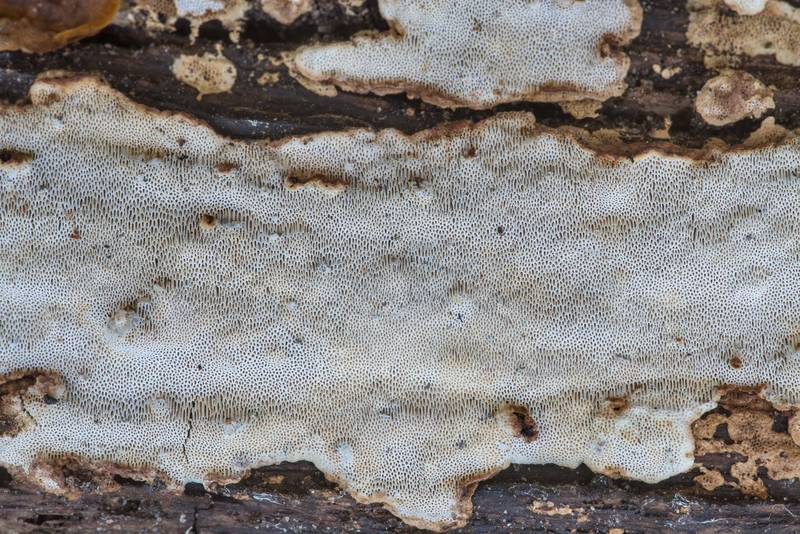

White and brown resupinate polypore mushroom on a fallen oak in Hensel Park. College Station, Texas


Album 2608: College Station - Sam Houston Forest, Texas, December 3 - 7, 2019
The image depicts a close-up view of a white and brown resupinate polypore mushroom growing on a fallen oak tree in Hensel Park, College Station, Texas. The mushroom is characterized by its unique growth pattern, where it grows flatly against the surface of the wood, rather than forming a raised fruiting body.
The mushroom's upper surface is covered with small, white, tooth-like structures that resemble tiny teeth or spines. These structures are likely responsible for the mushroom's ability to break down and absorb nutrients from the surrounding wood. The underside of the mushroom appears to be brownish in color, which may indicate the presence of a dense layer of hyphae (branching filaments) that help to anchor the fungus to the substrate.
The background of the image shows the rough, weathered surface of the fallen oak tree, with visible cracks and crevices where the mushroom has begun to colonize. The overall appearance suggests that the mushroom is in an early stage of development, possibly just starting to establish itself on the new host material.
Overall, the image provides a detailed look at the morphology of this resupinate polypore mushroom and its interaction with its environment. It highlights the unique characteristics of this type of fungus and its ability to thrive in certain ecological niches. – AI vision
🇪🇸 Descripción en español / Spanish Description
Un hongo poliporo resupinado blanco y marrón en un roble caído en Hensel Park. College Station, Texas, diciembre de 3, 2019. La imagen muestra una vista de cerca de un hongo poliporo resupinado blanco y marrón que crece sobre un roble caído en Hensel Park, College Station, Texas. El hongo se caracteriza por su único patrón de crecimiento, donde crece plano contra la superficie de la madera, en lugar de formar un cuerpo fructífero elevado. La superficie superior del hongo está cubierta con pequeñas estructuras dentadas blancas que se asemejan a dientes o espinas. Es probable que estas estructuras sean las responsables de la capacidad del hongo para descomponer y absorber nutrientes de la madera circundante. La cara inferior del hongo parece ser pardusca, lo que puede indicar la presencia de una densa capa de hifas (filamentos ramificados) que ayudan a anclar el hongo al sustrato. El fondo de la imagen muestra la superficie áspera y desgastada del roble caído, con grietas y hendiduras donde el hongo ha comenzado a colonizar. El aspecto general sugiere que el hongo está en una etapa temprana de desarrollo, posiblemente comenzando a establecerse en el nuevo material del anfitrión. En general, la imagen proporciona un detallado vistazo de la morfología de este hongo poliporo resupinado y su interacción con su entorno. Destaca las características únicas de este tipo de hongos y su capacidad para prosperar en ciertos nichos ecológicos. – Spanish translation


