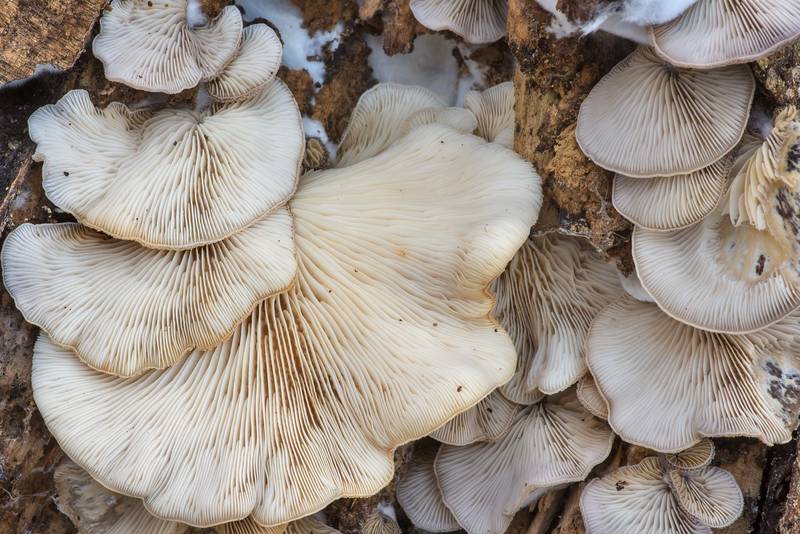

Oysterling mushrooms Crepidotus mollis on a fallen oak branch on North Wilderness Trail of Little Lake Creek Wilderness in Sam Houston National Forest north from Montgomery. Texas


Album 2612: Sam Houston Forest, Texas, December 14, 2019
The image presents a close-up view of oysterling mushrooms (Crepidotus mollis) growing on a fallen oak branch. The mushrooms are clustered together, with some partially overlapping others, and feature white caps that have begun to turn brown around their edges.
**Key Features:**
* **Mushrooms:** The mushrooms exhibit a distinctive fan-shaped cap, typically 1-3 cm wide and 2-5 cm tall.
* **Cap Coloration:** Initially white, the caps gradually darken over time.
* **Growth Habitat:** Found on decaying wood, particularly oak branches.
* **Distribution:** Common in North America.
**Image Details:**
* **Background:** The fallen oak branch serves as a natural substrate for the mushrooms' growth.
* **Lighting:** Soft, diffused lighting accentuates the delicate features of the mushrooms.
* **Composition:** The image is cropped to focus attention on the mushrooms, with minimal background elements visible.
**Overall Impression:**
The image effectively captures the intricate details of oysterling mushrooms in their natural habitat. The soft lighting and close-up perspective create a sense of intimacy, inviting the viewer to appreciate the beauty of these understated organisms. – AI vision
🇪🇸 Descripción en español / Spanish Description
Los hongos Oysterling Crepidotus mollis en una rama de roble caído en North Wilderness Trail de Little Lake Creek Wilderness en Sam Houston National Forest al norte de Montgomery, Texas, el 14 de diciembre de 2019. La imagen presenta una vista detallada de los hongos Oysterling (Crepidotus mollis) que crecen en una rama de roble caído. Los hongos están agrupados, con algunos superponiéndose parcialmente a otros, y tienen un sombrero blanco que ha empezado a oscurecerse alrededor de sus bordes. **Principales características:** * **Hongos:** Los hongos presentan un distintivo sombrero en forma de abanico, por lo general de 1-3 cm de ancho y 2-5 cm de alto. * **Coloración del Sombrero:** Inicialmente blanco, el sombrero va oscureciéndose con el tiempo. * **Hábitat de Crecimiento:** Se encuentra en madera en descomposición, particularmente ramas de roble. * **Distribución:** Común en Norteamérica. **Detalles de la Imagen:** * **Fondo:** La rama de roble caído sirve como sustrato natural para el crecimiento de los hongos. * **Iluminación:** Iluminación suave y difusa que acentúa las delicadas características de los hongos. * **Composición:** La imagen está recortada para concentrar la atención en los hongos, con un mínimo de elementos del fondo visibles. **Impresión General:** La imagen captura eficazmente los detalles complejos de los hongos Oysterling en su hábitat natural. La iluminación suave y la perspectiva cercana crean una sensación de intimidad, invitando al espectador a apreciar la belleza de estos organismos discretos. – Spanish translation


