
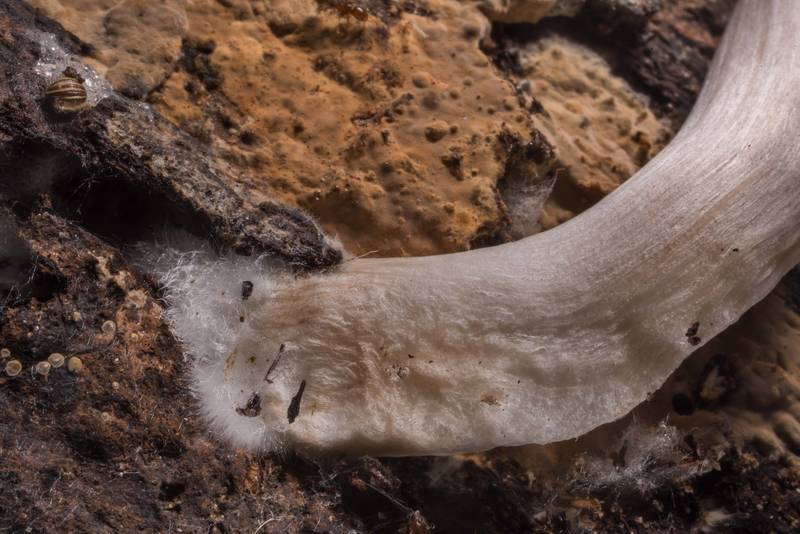

Brown corticioid fungus with base of Pluteus mushroom at Lake Somerville Trailway near Birch Creek Unit of Somerville Lake State Park. Texas


Album 2616: Mushrooms at Lake Somerville, Texas, December 21, 2019
The image presents a close-up view of the lower portion of a Pluteus mushroom's stem on top of a corticioid fungus, which is brown and has a rough texture. The base of the Pluteus mushroom appears to be covered with a white substance, possibly a mycelium or fungal growth.
**Key Features:**
* **Pluteus Mushroom:** The mushroom in question belongs to the genus Pluteus, characterized by its distinctive cap shape and gills underneath.
* **Corticioid Fungus:** This type of fungus is typically brown or tan in color and has a rough, cracked texture. It often grows on decaying wood or other organic matter.
* **White Substance:** The white substance covering the base of the Pluteus mushroom could be a mycelium, which is the vegetative part of a fungus that consists of branching filaments called hyphae. Mycelia play a crucial role in breaking down organic matter and absorbing nutrients from their surroundings.
**Context:**
* **Location:** The image was taken near Birch Creek Unit of Somerville Lake State Park in Texas.
* **Date:** December 21, 2019
Overall, the image provides a detailed look at the base of a Pluteus mushroom growing on top of a corticioid fungus, highlighting the unique characteristics of each organism and their potential ecological interactions. – AI vision
🇪🇸 Descripción en español / Spanish Description
El hongo corticial con la base de un hongo pluteo en el Lake Somerville Trailway cerca de Birch Creek Unidad del Somerville Lake State Park. Texas, 21 de diciembre de 2019. La imagen presenta una vista detallada de la parte inferior de un tallo de hongo pluteo encima de un hongo corticial, que es de color marrón y tiene una textura áspera. La base del hongo pluteo parece estar cubierta con una sustancia blanca, posiblemente un micelio o crecimiento fúngico. **Características clave:** * **Hongo Pluteo:** El hongo en cuestión pertenece al género Pluteus, caracterizado por su distintiva forma de sombrero y las guarniciones debajo. * **Hongo Corticial:** Este tipo de hongo es típicamente de color marrón o castaño y tiene una textura áspera y agrietada. Crece a menudo en madera en descomposición u otra materia orgánica. * **Sustancia Blanca:** La sustancia blanca que cubre la base del hongo pluteo podría ser un micelio, que es la parte vegetativa de un hongo que consiste en filamentos ramificados llamados hifas. Los micelios desempeñan un papel crucial en la descomposición de la materia orgánica y absorben nutrientes de sus alrededores. **Contexto:** * **Ubicación:** La imagen se tomó cerca de Birch Creek Unidad del Somerville Lake State Park, Texas. * **Fecha:** 21 de diciembre de 2019 En general, la imagen proporciona una vista detallada de la base de un hongo pluteo creciendo encima de un hongo corticial, destacando las características únicas de cada organismo y sus potenciales interacciones ecológicas. – Spanish translation


