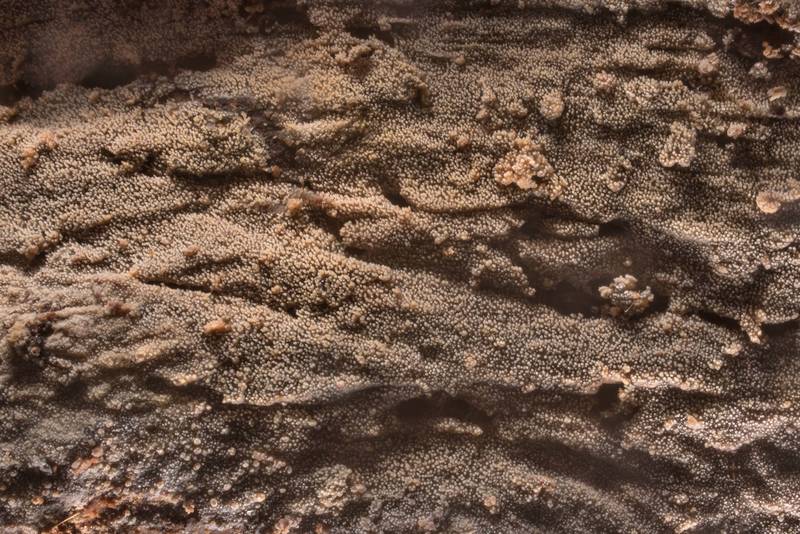
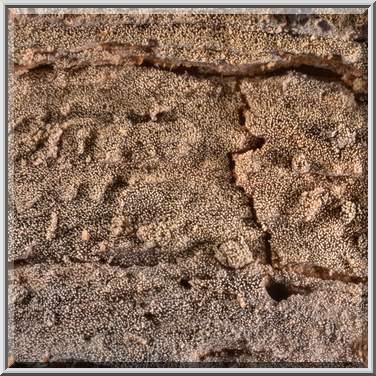
Texture of a hydnoid (tooth) fungus under a fallen oak at Lake Somerville Trailway near Birch Creek Unit of Somerville Lake State Park. Texas


Album 2616: Mushrooms at Lake Somerville, Texas, December 21, 2019
The image showcases the intricate texture of a hydnoid (tooth) fungus that has grown on the underside of a fallen oak tree. The dark brown to black surface of the mushroom exhibits numerous small, tooth-like protrusions that cover its entire surface.
These teeth appear as tiny white or light-brown structures, which are likely hyphae, the branching filaments that form the mycelium (vegetative part) of the fungus. They may also be remnants of spores that have germinated and begun to grow, indicating a stage in the life cycle where the fungus is actively producing reproductive structures.
The texture of the image resembles that of the surface of an old piece of leather or suede fabric, with its irregularities and ridges giving it a worn appearance. This visual similarity may be due to the fact that both the mushroom's surface and the fabric have undergone significant wear and tear over time, resulting in similar patterns of degradation.
Overall, the image provides a detailed view of the unique texture and structure of this particular species of fungus, highlighting its intricate growth patterns and potential for further study. – AI vision
🇪🇸 Descripción en español / Spanish Description
La textura de un hongo hidnoide (diente) debajo de un roble caído en el Lake Somerville Trailway cerca de Birch Creek Unit del Somerville Lake State Park. Texas, 21 de diciembre de 2019. La imagen muestra la intrincada textura de un hongo hidnoide (diente) que ha crecido en la parte inferior de un roble caído. La superficie marrón oscuro a negro del hongo presenta numerosas protuberancias pequeñas y dentadas que cubren toda su superficie. Estos dientes aparecen como estructuras blancas o parduzcas pequeñas, que son probablemente hifas, los filamentos ramificados que forman el micelio (parte vegetativa) del hongo. También pueden ser restos de esporas que han germinado y comenzado a crecer, lo que indica una etapa en el ciclo vital donde el hongo está produciendo activamente estructuras reproductivas. La textura de la imagen recuerda a la superficie de un viejo trozo de cuero o tela de gamuza, con sus irregularidades y aristas dando una apariencia desgastada. Esta similitud visual puede deberse al hecho de que tanto la superficie del hongo como el tejido han sufrido un desgaste significativo a lo largo del tiempo, dando lugar a patrones de degradación similares. En general, la imagen proporciona una vista detallada de la textura y estructura únicas de esta especie particular de hongo, destacando sus intrincados patrones de crecimiento y potencial para estudios posteriores. – Spanish translation