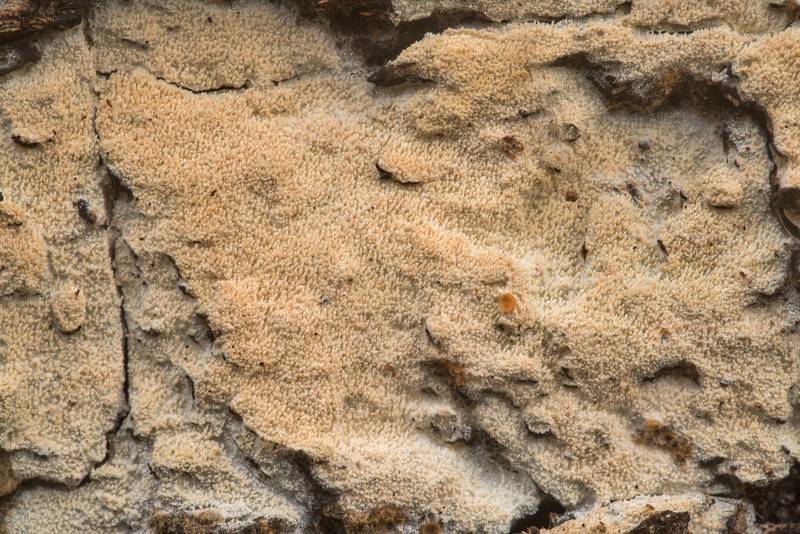

Details of prostrate tooth fungus on bark under an oak log on Caney Creek section of Lone Star Hiking Trail in Sam Houston National Forest north from Montgomery. Texas


Album 2626: Sam Houston Forest, Texas, January 12, 2020
The image presents a close-up view of the underside of an oak log, featuring a dense growth of small, white to yellowish-brown spores resembling tiny teeth.
**Key Features:**
* The fungus is likely **Poria praetermissa**, also known as prostrate tooth fungus.
* It grows on decaying wood, particularly oak logs, with the majority of its mass concentrated at the base and tapering towards the top.
* Its small, white to yellowish-brown spores resemble tiny teeth, giving it a distinctive appearance.
**Coloration and Texture:**
* The overall color is predominantly white to yellowish-brown, matching the provided caption.
* The texture appears rough and irregular, with the fungus covering much of the underside of the oak log.
**Context and Significance:**
* The image was taken in January 2020 on Caney Creek section of Lone Star Hiking Trail in Sam Houston National Forest north from Montgomery. Texas.
* The location suggests a humid subtropical climate with mild winters, which is conducive to the growth of various types of fungi.
* The presence of **Poria praetermissa** indicates that the oak log has been decaying for some time, providing an environment suitable for the fungus's growth.
In summary, the image provides a detailed view of **Poria praetermissa**, showcasing its unique characteristics and habitat. – AI vision
🇪🇸 Descripción en español / Spanish Description
Los detalles del hongo en forma de dientes prostrado sobre la corteza bajo un tronco de roble en el tramo de Caney Creek del sendero Lone Star Hiking Trail en el Bosque Nacional Sam Houston al norte de Montgomery, Texas, el 12 de enero de 2020. La imagen presenta una vista de cerca de la parte inferior de un tronco de roble, con un crecimiento denso de pequeñas esporas blancas a parduzcas amarillentas que recuerdan dientes pequeños. * Principales características:
* El hongo es probablemente **Poria praetermissa**, también conocido como hongo en forma de dientes prostrado. * Crea crecimiento en madera podrida, especialmente troncos de roble, con la mayor parte de su masa concentrada en la base y estrechándose hacia arriba. * Sus pequeñas esporas blancas a parduzcas amarillentas recuerdan dientes pequeños, lo que le da un aspecto distintivo. * Coloración y Textura:
* El color general es predominantemente blanco a parduzco amarillento, coincidiendo con la leyenda proporcionada. * La textura parece áspera e irregular, cubriendo el hongo gran parte de la parte inferior del tronco de roble.
* Contexto y Significado:
* La imagen se tomó en enero de 2020 en el tramo de Caney Creek del sendero Lone Star Hiking Trail en el Bosque Nacional Sam Houston al norte de Montgomery, Texas. * El lugar sugiere un clima húmedo subtropical con inviernos suaves, lo que es propicio para el crecimiento de varios tipos de hongos. * La presencia de **Poria praetermissa** indica que el tronco de roble ha estado en proceso de descomposición durante algún tiempo, proporcionando un entorno adecuado para el crecimiento del hongo. En resumen, la imagen proporciona una vista detallada de **Poria praetermissa**, mostrando sus características únicas y su hábitat. – Spanish translation