
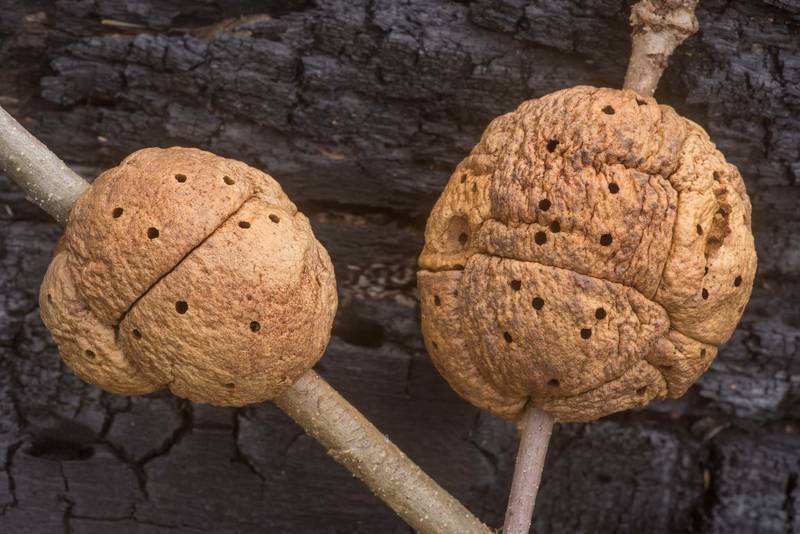

Spongy rounded growth (oak apple galls) on young oaks on Stubblefield section of Lone Star hiking trail north from Trailhead No. 6 in Sam Houston National Forest. Texas


Album 2647: Sam Houston Forest, Texas, February 16, 2020
The image depicts a close-up view of three spherical growths, commonly referred to as oak apple galls, attached to the branches of young oaks. The oak apple gall is caused by a wasp in the family Cynipidae that lays its eggs on the leaves of the plant. Upon hatching, the larvae burrow into the leaf tissue and induce the formation of these characteristic growths.
**Key Features:**
* **Growth Appearance**: Each oak apple gall exhibits a soft, spongy texture with a rounded shape.
* **Coloration**: The galls display a light brown hue that is likely caused by the wasp's eggs or larvae within them.
* **Branch Attachment**: The galls are attached to the branches of young oaks, which appear slender and gray in color.
**Background:**
The background of the image features the rough bark of a tree branch, characterized by deep cracks. This suggests that the oak trees are mature enough to have developed thick trunks with rough bark.
**Caption Context:**
The caption indicates that this photograph was taken on February 16, 2020, in Sam Houston National Forest, Texas. It is part of a series documenting various species found along the Stubblefield section of Lone Star hiking trail north from Trailhead No. 6. – AI vision
🇪🇸 Descripción en español / Spanish Description
El crecimiento esponjoso redondeado (gallos de manzana de roble) en robles jóvenes en la sección Stubblefield del sendero de excursión Lone Star al norte desde el punto de partida n. ° 6 en la Selva Nacional Sam Houston. Texas, 16 de febrero de 2020. La imagen representa una vista detallada de tres crecimientos esféricos, comúnmente llamados gallos de manzana de roble, unidos a las ramas de robles jóvenes. El galo de manzano de roble está causado por una avispa en la familia Cynipidae que pone sus huevos en las hojas de la planta. Al eclosionar, las larvas hacen túneles en el tejido de las hojas e inducen la formación de estos crecimientos característicos. **Características principales:** * **Aspeto del crecimiento**: Cada galo de manzana de roble exhibe una textura esponjosa y suave con una forma redondeada. * **Coloración**: Los galls presentan un tono marrón claro causado probablemente por los huevos o las larvas de la avispa dentro de ellos. * **Unión a la rama**: Los galls están unidos a las ramas de robles jóvenes, que aparecen delgadas y grises en color. **Contexto del fondo:** El fondo de la imagen presenta la corteza áspera de una rama de un árbol, caracterizada por profundas grietas. Esto sugiere que los robles son lo suficientemente maduros como para haber desarrollado troncos gruesos con corteza áspera. **Contexto del subtítulo:** El subtítulo indica que esta fotografía fue tomada el 16 de febrero de 2020 en la Selva Nacional Sam Houston, Texas. Forma parte de una serie que documenta las diferentes especies encontradas a lo largo de la sección Stubblefield del sendero de excursión Lone Star al norte desde el punto de partida n. ° 6. – Spanish translation


