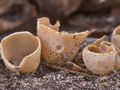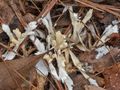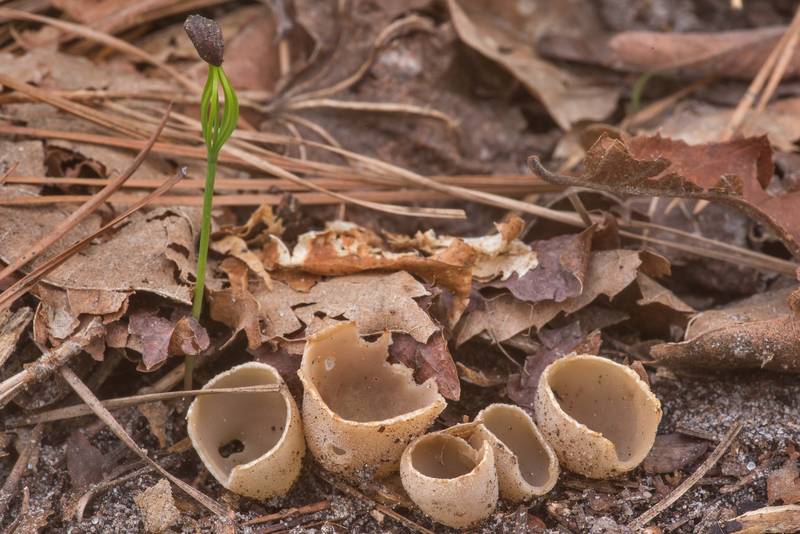

Toothed cup fungus (Tarzetta cupularis) under pine needles and oak leaves on Caney Creek Trail (Little Lake Creek Loop Trail) in Sam Houston National Forest north from Montgomery. Texas


Album 2653: Sam Houston National Forest near Montgomery, Texas, February 29, 2020
The image presents a close-up view of the ground covered with dry brown pine needles and oak leaves, featuring several small tan-colored cups scattered across it. The cups are characterized by their rough, toothed edges and have an irregular shape, some being larger than others.
In the center of the image, one cup stands out due to its distinctive dark brown coloration at the top, which is likely a result of the caps not fully detaching from the stems. A small green sprout emerges from the cups in the background, adding a pop of color to the otherwise muted tones.
The overall atmosphere of the image suggests that it was captured on a cool winter day when the fungus had recently emerged from the ground. The presence of pine needles and oak leaves indicates that the scene is set in a forested area, possibly with coniferous trees such as pines or spruces. The fact that the cups are scattered about implies that they have been growing in this location for some time.
Overall, the image provides a detailed look at the Toothed cup fungus (Tarzetta cupularis) and its habitat, offering insight into the natural world of fungi and their relationship with their environment. – AI vision
🇪🇸 Descripción en español / Spanish Description
El hongo de copa dentada (Tarzetta cupularis) bajo las agujas de pino y hojas de roble en el Sendero del Arroyo Caney (Sendero del Boulevard Little Lake Creek) en la Selva Nacional Sam Houston al norte de Montgomery. Texas, 29 de febrero de 2020. La imagen muestra una vista cercana del suelo cubierto con agujas secas marrones y hojas de roble, con varias copas pequeñas de color canela dispersadas en él. Las copas se caracterizan por sus bordes dentados ásperos y tienen una forma irregular, algunas son más grandes que otras. En el centro de la imagen, una copa destaca debido a su distintiva coloración marrón oscuro en la parte superior, lo que es probablemente el resultado de las tapas que no se separan por completo de los tallos. Un pequeño brote verde emerge de las copas en segundo plano, agregando un toque de color a los tonos atenuados. El ambiente general de la imagen sugiere que se capturó en un frío día de invierno cuando el hongo había emergido recientemente del suelo. La presencia de agujas de pino y hojas de roble indica que la escena está ubicada en un área boscosa, posiblemente con árboles coníferos como pinos o abetos. El hecho de que las copas estén dispersas implica que han estado creciendo en este lugar durante algún tiempo. En general, la imagen proporciona una mirada detallada al hongo de copa dentada (Tarzetta cupularis) y su hábitat, ofreciendo insight al mundo natural de los hongos y su relación con su entorno. – Spanish translation