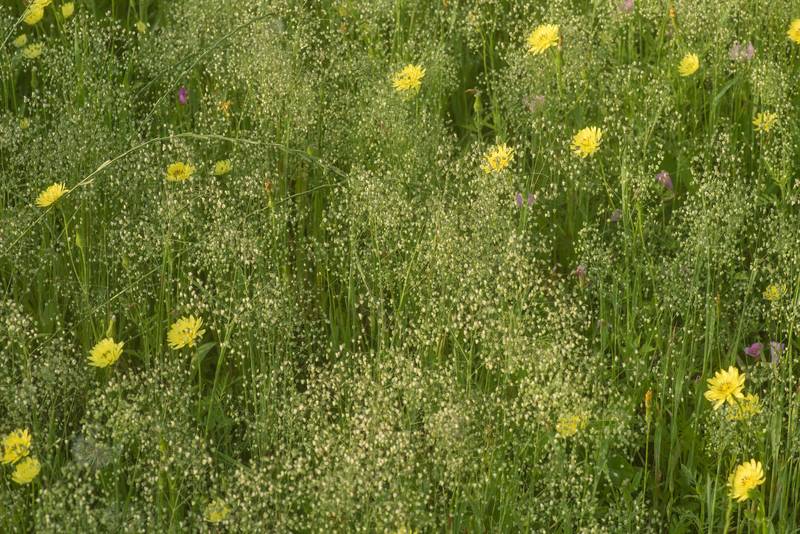

Little quaking grass (Briza minor) and Texas dandelion in TAMU Horticultural Gardens in Texas A&M University. College Station, Texas


Album 2691: College Station - Sam Houston Forest, Texas, April 21 - 23, 2020
The image showcases a vibrant field of wildflowers and grasses, with a focus on two prominent species: Little Quaking Grass (Briza minor) and Texas Dandelion.
In the foreground, the Little Quaking Grass stands out due to its unique shape and color. This perennial grass is characterized by its delicate, lacy plumes that resemble tiny bells or quivering leaves. The pale yellow-green inflorescence of the plant adds a soft, ethereal quality to the scene. In contrast, the Texas Dandelion (Pyrrhopappus texensis) boasts vibrant yellow flowers with distinctive petals and a fuzzy texture. These dandelions are scattered throughout the field, adding splashes of color against the lush green grass.
Beyond these two species, the image reveals a diverse array of wildflowers and grasses. The Little Quaking Grass dominates the landscape, with its tall stems swaying gently in the breeze. In some areas, it forms dense clumps that create a sense of texture and depth. Meanwhile, the Texas Dandelions are more dispersed, often growing alongside other wildflowers like Purple Vervain (Verbena spp.) or Indian Paintbrush (Castilleja indivisa). These plants add pops of color to the scene, creating a dynamic interplay between light and shadow.
The background of the image features a soft, blurred effect that emphasizes the lushness of the field. The camera's shallow depth of field highlights the textures and colors of the wildflowers, while subtly blurring the surrounding environment. This technique creates a sense of intimacy and immediacy, as if the viewer is standing within the field itself.
Overall, this image captures the beauty and diversity of a thriving wildflower meadow in Texas. By highlighting two prominent species – Little Quaking Grass and Texas Dandelion – it showcases the unique characteristics of these plants while also revealing the intricate relationships between them and their surroundings. – AI vision
🇪🇸 Descripción en español / Spanish Description
En los Jardines Hortícolas de la Universidad A&M en Texas, el 21 de abril del 2020. La imagen muestra un campo vibrante de flores silvestres y hierbas, con énfasis en dos especies prominentes: Hierba Temblorosa (Briza minor) y Diente de León de Texas. En primer plano, la Hierba Temblorosa destaca por su forma única y color. Esta hierba perenne se caracteriza por sus delicadas plumas acolchadas que recuerdan a pequeñas campanas o hojas temblorosas. La inflorescencia de color verde amarillento pálido de la planta agrega una cualidad suave y etérea a la escena. En contraste, el Diente de León de Texas (Pyrrhopappus texensis) exhibe vibrantes flores amarillas con pétalos distintivos y una textura peluda. Estos dientes de león están dispersos por todo el campo, añadiendo toques de color al verde musgo del campo. Más allá de estas dos especies, la imagen revela una diversa gama de flores silvestres y hierbas. La Hierba Temblorosa domina el paisaje, con sus tallos altos que ondean suavemente en la brisa. En algunas áreas, forma densos racimos que crean una textura y profundidad. Mientras tanto, los Dientes de León de Texas se encuentran más dispersos, a menudo creciendo al lado de otras flores silvestres como el Verbena (Verbena spp.) o la Pincel Blanco (Castilleja indivisa). Estas plantas añaden toques de color a la escena, creando una interacción dinámica entre luz y sombra. El fondo de la imagen presenta un efecto difuminado suave que enfatiza el verde exuberante del campo. La profundidad de campo superficial de la cámara resalta las texturas y colores de las flores silvestres, al tiempo que borra ligeramente el entorno circundante. Esta técnica crea una sensación de intimidad e inmediatez, como si el espectador estuviera dentro del campo mismo. En general, esta imagen capta la belleza y diversidad de un prado de flores silvestres en Texas. Al destacar dos especies prominentes - Hierba Temblorosa y Diente de León de Texas - muestra las características únicas de estas plantas al tiempo que revela las intrincadas relaciones entre ellas y sus entornos. – Spanish translation