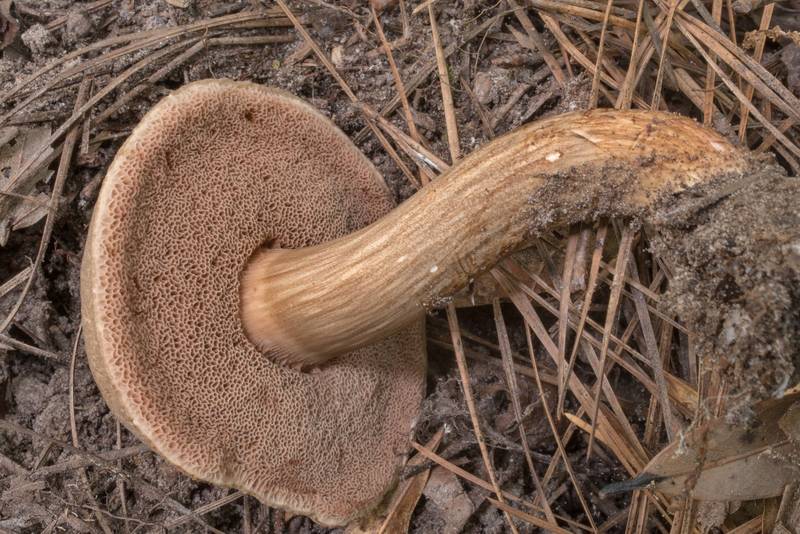

Underside of a bolete mushroom Porphyrellus sordidus on floodplain on Caney Creek Trail (Little Lake Creek Loop Trail) in Sam Houston National Forest north from Montgomery. Texas


Album 2711: Sam Houston Forest, Texas, May 23, 2020
The image presents a detailed view of the underside of a bolete mushroom, specifically the Porphyrellus sordidus species. The mushroom's cap is characterized by its light brown color and features a network of fine, interwoven lines that resemble a lace-like pattern. This intricate texture suggests a high level of detail in the mushroom's growth process.
The stem of the mushroom is long and slender, extending from the base of the cap to the ground below. It appears to be covered with small, white spots or patches, which may indicate the presence of spores or other microscopic features that contribute to the mushroom's reproductive cycle.
In terms of its habitat, the image shows the mushroom growing on a floodplain within Sam Houston National Forest in Texas. The surrounding environment is characterized by a mix of dirt and grasses, with some dead plant material visible in the background. This suggests that the mushroom has adapted to thrive in this specific ecosystem, where it can absorb nutrients from the soil and benefit from the presence of nearby vegetation.
Overall, the image provides a fascinating glimpse into the world of fungi, highlighting the intricate details of the Porphyrellus sordidus mushroom's structure and its relationship with its environment. – AI vision
🇪🇸 Descripción en español / Spanish Description
La cara inferior de un hongo bolete Porphyrellus sordidus en una llanura inundable en Caney Creek Trail (Little Lake Creek Loop Trail) en el bosque nacional Sam Houston al norte de Montgomery, Texas, el 23 de mayo del 2020. La imagen presenta una vista detallada de la cara inferior de un hongo bolete, específicamente la especie Porphyrellus sordidus. El sombrero del hongo se caracteriza por su color marrón claro y cuenta con una red de líneas entrelazadas finas que recuerdan a un patrón similar a encaje. Esta textura compleja sugiere un alto nivel de detalle en el proceso de crecimiento del hongo. El tallo del hongo es largo y delgado, extendiéndose desde la base del sombrero hasta el suelo abajo. Parece estar cubierto con pequeñas manchas o parches blancos, lo que puede indicar la presencia de esporas u otras características microscópicas que contribuyen al ciclo reproductivo del hongo. En términos de su hábitat, la imagen muestra el hongo creciendo en una llanura inundable dentro del bosque nacional Sam Houston en Texas. El entorno circundante se caracteriza por una mezcla de tierra y hierbas, con algo de material vegetal muerto visible en el fondo. Esto sugiere que el hongo se ha adaptado para prosperar en este ecosistema específico, donde puede absorber nutrientes del suelo y beneficiarse de la presencia de vegetación cercana. En general, la imagen proporciona un fascinante vistazo al mundo de los hongos, resaltando los detalles complejos de la estructura del hongo Porphyrellus sordidus y su relación con su entorno. – Spanish translation