 |
| |||||||||||||||||

| ||||||||||||||||||


| Similar |   |
  |
  |
  |
  |
| |||||||||||||||||||||||||||||
| |||||||||||||||||||||||||||||
| 1996 1997 1998 1999 2000 2001 2002 2003 2004 2005 2006 2007 2008 2009 2010 2011 2012 2013 2014 2015 2016 2017 2018 2019 2020 2021 2022 2023 2024 2025 2026 | |||||||||||||||||||||||||||||
| New version Slide Show Most Popular Full List Statistics Technical Details Home Page | |||||||||||||||||||||||||||||
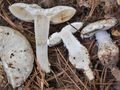
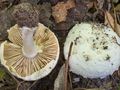
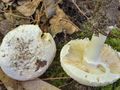
While exploring the Caney Creek Trail (part of the Little Lake Creek Loop Trail) in Sam Houston National Forest, located north of Montgomery, Texas, I had the opportunity to study the intricate details of Amanita subsolitaria mushrooms on June 13, 2020. Through careful observation and photography, I was able to capture the unique features of these fascinating fungi in their natural habitat. – generated by AI |
The image depicts a close-up of several white mushroom caps with thick stems and gills, partially dissected to show their underside. The mushrooms are set against a backdrop of brown leaves, pine needles, twigs, and green moss or ferns. A few of the larger pieces of debris have been moved aside in order to reveal the full extent of the fungi's structure, which is quite unique: the stem has a thick, fibrous base that resembles the roots of trees. The mushroom's cap itself appears to be made up of thin, overlapping layers that resemble the petals of flowers. The mushrooms are likely Amanita subsolitaria (also known as the "false death cap"), a species native to North America and Europe. They are characterized by their white caps with brownish-red spots or patches, long white stems, and white gills. The false death cap is considered poisonous and should not be eaten. The image was taken on Caney Creek Trail (Little Lake Creek Loop Trail) in Sam Houston National Forest north from Montgomery, Texas, USA. – AI vision |
Los hongos Amanita subsolitaria(?) disecados se encontraron en el camino de Caney Creek (Sendero del bucle del lago Little) en la selva nacional Sam Houston al norte de Montgomery, Texas, el 13 de junio de 2020. La imagen muestra un primer plano de varias copas blancas de hongo con tallos gruesos y guarniciones, parcialmente diseccionados para mostrar su parte inferior. Los hongos están ubicados contra el fondo de hojas marrones, agujas de pino, ramitas y musgo verde o helechos. Algunos de los trozos más grandes de desechos se han movido a un lado para revelar toda la extensión de la estructura del hongo, que es bastante única: el tallo tiene una base fibrosa gruesa que se parece a las raíces de árboles. La copa misma del hongo parece estar compuesta por capas superpuestas delgadas que se asemejan a los pétalos de las flores. Es probable que los hongos sean Amanita subsolitaria (también conocidos como el "falso sombrero de la muerte"), una especie nativa de América del Norte y Europa. Se caracterizan por sus copas blancas con manchas o parches parduzcos rojizos, tallos blancos largos y guarniciones blancas. El falso sombrero de la muerte se considera venenoso y no debe comerse. La imagen se tomó en el camino de Caney Creek (Sendero del bucle del lago Little) en la selva nacional Sam Houston al norte de Montgomery, Texas, EE. UU. – Spanish translation |
Keyword variants
high resolution online digital collection
Creek Loop Trail picture show
Lake Creek Loop snapshot
Houston National Forest shot
Caney Creek Trail photograph
Lone Star State
Little Lake images
United States
picture gallery
photo album
documentary photographs
daily pics
TX
travelogue
snapshots
sightseeing
photowalks
photoblog
littel
graphic
fungus
fungi
fotografias
foto
America