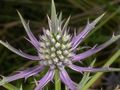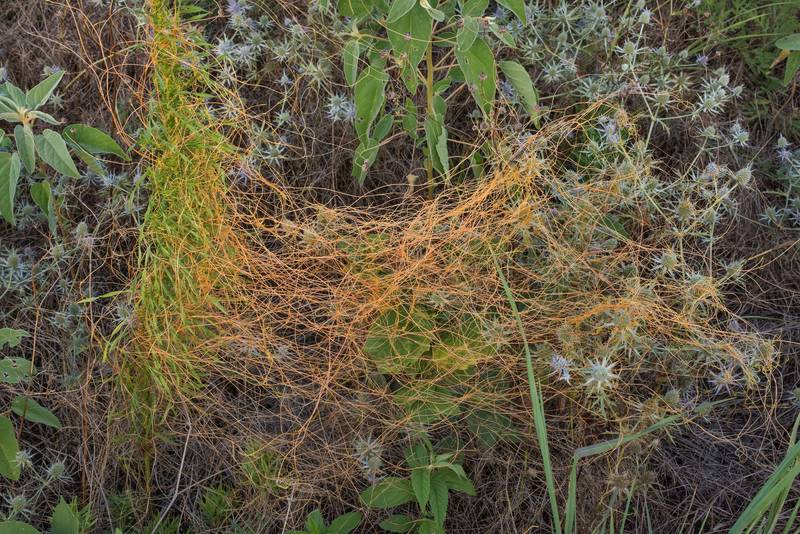

Dodder (Cuscuta) on Hooker's eryngo (Eryngium hookeri) at Lake Somerville Trailway near Birch Creek Unit of Somerville Lake State Park. Texas


Album 2740: Lake Somerville, Texas, July 19, 2020
The image displays a close-up view of a tangled mass of orange-colored vines or fibers interwoven among green leaves and purple flowers. The orange tendrils appear to be growing from one another, forming an interconnected web. They are surrounded by various types of green plants with small blueish-purple flowers.
In the center of the image is what appears to be the main plant, a tall stem with large leaves, which has been overgrown by several layers of dodder (Cuscuta). The dodder's tendrils have wrapped themselves around the stems and leaves of other plants in the area.
The purple flowers are likely a type of wildflower that grows in this region.
The image suggests that the dodder is actively growing and spreading, covering its host plant with an extensive network of vines. This behavior is typical of Cuscuta species, which are known to be parasitic on other plants, obtaining nutrients from their hosts through specialized roots called haustoria.
In this case, the dodder appears to have established itself on a native Texas wildflower, Eryngium hookeri (Hooker's eryngo), but it is unclear whether it has completely taken over the plant or if there are still other plants nearby that might be its host.
Overall, the image provides a detailed look at the unique characteristics of dodder and its parasitic relationship with its hosts. – AI vision
🇪🇸 Descripción en español / Spanish Description
La enredadera (Cuscuta) sobre el Eryngio de Hooker (Eryngium hookeri) en la Lake Somerville Trailway cerca de Birch Creek Unidad de Somerville Lake State Park, Texas, 19 de julio de 2020. La imagen muestra una vista detallada de una masa enredada de vides o fibras de color naranja entremezcladas con hojas verdes y flores púrpuras. Los tentáculos naranjas parecen estar creciendo uno del otro, formando una red interconectada. Están rodeados por varios tipos de plantas verdes con pequeñas flores azuladas-púrpura. En el centro de la imagen se encuentra lo que parece ser la planta principal, un tallo grande con hojas grandes, sobrecrecido por varias capas de enredadera (Cuscuta). Los tentáculos de la enredadera se han envuelto alrededor de los tallos y hojas de otras plantas de la zona. Las flores púrpuras son probablemente un tipo de flor silvestre que crece en esta región. La imagen sugiere que la enredadera está creciendo y propagándose activamente, cubriendo su planta hospedadora con una extensa red de vides. Este comportamiento es típico de las especies de Cuscuta, que se sabe que son parásitas de otras plantas, obteniendo nutrientes de sus huéspedes a través de raíces especializadas llamadas haustorias. En este caso, la enredadera parece haberse establecido en una flor silvestre nativa de Texas, Eryngium hookeri (Eryngio de Hooker), pero no está claro si ha completado totalmente la planta o si aún hay otras plantas cercanas que podrían ser su hospedador. En general, la imagen proporciona un detallado enfoque de las características únicas de la enredadera y su relación parasitaria con sus huéspedes. – Spanish translation