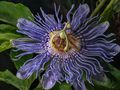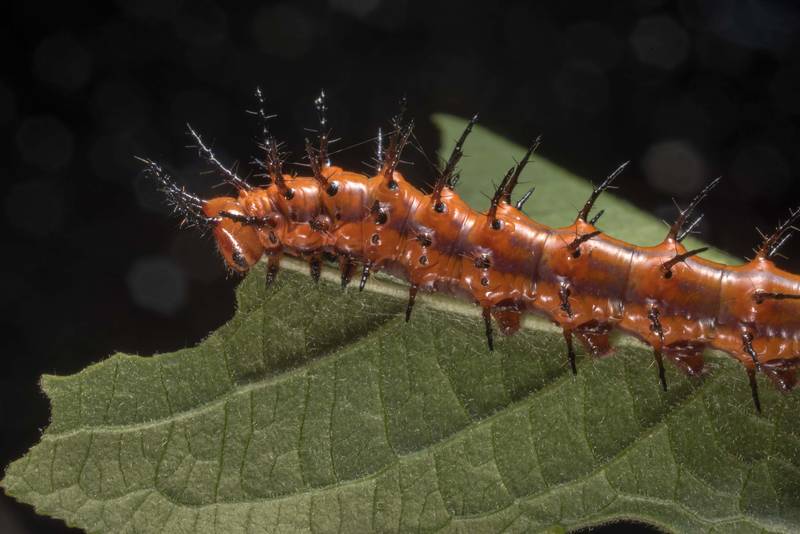

Leaf of maypop (Passiflora foetida) with a Gulf fritillary caterpillar in Washington-on-the-Brazos State Historic Site. Washington, Texas


Album 2742: Sam Houston Forest - Washington, Texas, July 24 - 25, 2020
The image depicts a Gulf Fritillary Caterpillar on the leaf of a Maypop plant (Passiflora foetida) at the Washington-on-the-Brazos State Historic Site in Texas.
**Caterpillar Description:**
* The caterpillar is brown with black spikes protruding from its body.
* Its body is segmented, indicating that it has recently molted and is preparing for the next stage of development.
* The caterpillar's legs are not visible as they are likely hidden underneath its body.
**Leaf Description:**
* The leaf is large and green, with a wavy edge and prominent veins.
* The leaf appears to be slightly curled up at the edges, possibly due to the weight of the caterpillar or environmental factors.
**Background:**
* The background of the image is dark and blurry, suggesting that it was taken in a shaded area or indoors.
* There are no other objects or features visible in the background, which helps to focus attention on the caterpillar and leaf.
**Overall Impression:**
* The image suggests that the Gulf Fritillary Caterpillar is an important part of the ecosystem at Washington-on-the-Brazos State Historic Site.
* The presence of the caterpillar on the Maypop plant indicates a symbiotic relationship between the two species, with the caterpillar relying on the plant for food and shelter. – AI vision
🇪🇸 Descripción en español / Spanish Description
Una oruga de la tortuga del golfo (Passiflora foetida) en el sitio histórico estatal Washington-on-the-Brazos. Washington, Texas, 25 de julio de 2020. La imagen muestra una oruga de la tortuga del Golfo en la hoja de una planta maypop (Passiflora foetida) en el sitio histórico estatal Washington-on-the-Brazos en Texas. **Descripción de la oruga:** * La oruga es marrón con puntas negras que sobresalen de su cuerpo. * Su cuerpo está segmentado, lo que indica que recientemente ha mudado y se está preparando para la siguiente etapa de desarrollo. * Las patas de la oruga no son visibles ya que están probablemente ocultas debajo de su cuerpo. **Descripción de la hoja:** * La hoja es grande y verde, con un borde ondulado y venas prominentes. * La hoja parece estar ligeramente curvada hacia arriba en los bordes, posiblemente debido al peso de la oruga o factores ambientales. **Antecedentes:** * El fondo de la imagen es oscuro y borroso, lo que sugiere que fue tomado en un área sombreada o en el interior. * No hay otros objetos u objetos visibles en segundo plano, lo que ayuda a centrar la atención en la oruga y la hoja. **Impresión general:** * La imagen sugiere que la oruga de la tortuga del Golfo es una parte importante del ecosistema en el sitio histórico estatal Washington-on-the-Brazos. * La presencia de la oruga en la planta maypop indica una relación simbiótica entre las dos especies, con la oruga que depende de la planta para comida y refugio. – Spanish translation