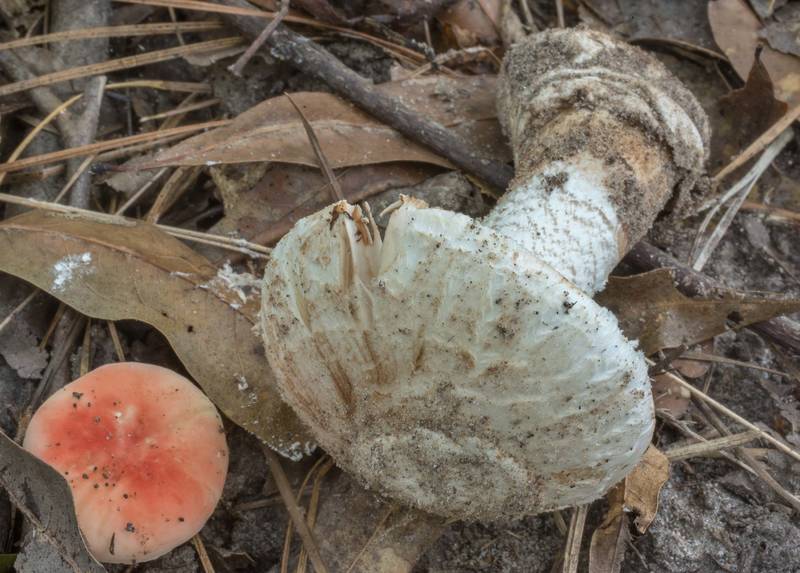

Cap of thick white Amanita mushroom in low lying area on Caney Creek Trail (Little Lake Creek Loop Trail) in Sam Houston National Forest north from Montgomery. Texas


Album 2749: College Station - Sam Houston Forest, Texas, August 6 - 7, 2020
The image depicts a close-up view of an Amanita mushroom, characterized by its thick white cap and stem. The cap is partially obscured by dirt and debris, while the stem appears to be covered in a white substance that may be mold or fungus.
**Key Features:**
* **Cap:** Thick white, partially obscured by dirt and debris
* **Stem:** Covered in white substance (mold/fungus)
* **Background:** Low-lying area on Caney Creek Trail (Little Lake Creek Loop Trail) in Sam Houston National Forest north from Montgomery. Texas
**Additional Details:**
* The mushroom is likely a species of Amanita, which are known for their distinctive caps and stems.
* The image suggests that the mushroom has been exposed to dirt and debris, possibly due to recent rainfall or flooding.
* The presence of mold or fungus on the stem indicates that the mushroom may be past its prime or even toxic.
**Overall:**
The image provides a detailed view of an Amanita mushroom in its natural habitat. The thick white cap and stem are characteristic features of this species, and the presence of dirt and debris suggests that the mushroom has been exposed to environmental factors that can affect its appearance and edibility. – AI vision
🇪🇸 Descripción en español / Spanish Description
El sombrero grueso y blanco del hongo Amanita en un área de baja altitud en el Sendero Caney Creek (Sendero Little Lake Creek Loop) en el Bosque Nacional Sam Houston al norte de Montgomery, Texas, el 7 de agosto de 2020. La imagen muestra una vista detallada del hongo Amanita, caracterizado por su sombrero grueso y blanco y un tallo. El sombrero está parcialmente oscurecido por la suciedad y los restos, mientras que el tallo parece estar cubierto de una sustancia blanca que puede ser moho u hongo. **Características clave:** * **Sombrero:** Grosor blanco, parcialmente oscurecido por la suciedad y los restos * **Tallo:** Cubierto de sustancia blanca (moho/hongo) * **Fondo:** Área baja en el sendero Caney Creek (Sendero Little Lake Creek Loop) en el Bosque Nacional Sam Houston al norte de Montgomery, Texas **Detalles adicionales:** * El hongo es probablemente una especie de Amanita, conocida por sus distintivos sombreros y tallos. * La imagen sugiere que el hongo ha estado expuesto a la suciedad y los restos, posiblemente debido a las recientes lluvias o inundaciones. * La presencia de moho o hongo en el tallo indica que el hongo puede haber pasado de su mejor momento o incluso ser tóxico. **En general:** la imagen proporciona una vista detallada del hongo Amanita en su hábitat natural. El grueso sombrero y el tallo son características distintivas de esta especie, y la presencia de suciedad y restos sugiere que el hongo ha estado expuesto a factores ambientales que pueden afectar su apariencia y comestibilidad. – Spanish translation