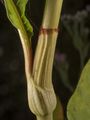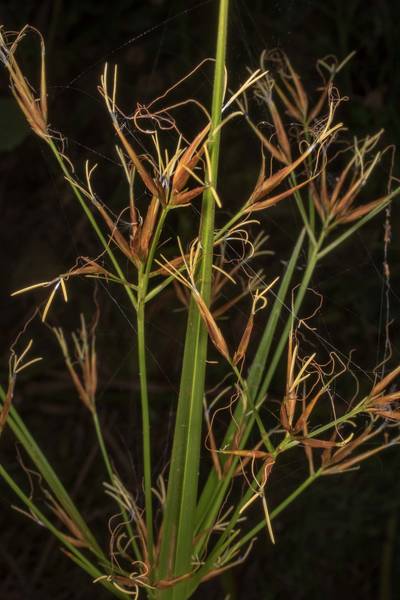

Beaksedge, probably Rhynchospora corniculata, on a shore of Somerville Lake near Birch Creek Unit of Somerville Lake State Park. Texas


Album 2761: Lake Somerville, Texas, August 29, 2020
The image features an inflorescence of Beaksedge (Rhynchospora corniculata), a perennial plant native to North and South America. The grass-like stem is green with smooth edges, growing from a single root system. The leaves are long and narrow, resembling blades of grass.
In the center of each leaf is an alternating arrangement of spiky bristles that curve outward toward the tip. At the top of each spikelet, three small flowers emerge. Each flower has three stamens (male reproductive organs) and three pistils (female reproductive organs). The inflorescence is composed of numerous spikelets arranged in a branching pattern.
The Beaksedge plant thrives in wetland environments, such as bogs, marshes, and swamps, with its roots absorbing moisture from the soil. It can also grow in shallow water or on mudflats. The plant produces seeds that disperse through wind or water, allowing it to colonize new areas.
The image captures a close-up view of the Beaksedge inflorescence, showcasing its unique characteristics and growth patterns. The photograph was taken near Somerville Lake State Park in Texas, highlighting the plant's presence in wetland ecosystems. – AI vision
🇪🇸 Descripción en español / Spanish Description
El pico de espiga, probablemente Rhynchospora corniculata, en una orilla del lago Somerville cerca de Birch Creek Unidad del Parque Estatal Lago Somerville. Texas, agosto 29, 2020. La imagen presenta una inflorescencia de pico de espiga (Rhynchospora corniculata), una planta perenne nativa de Norte y Sudamérica. El tallo parecido a hierba es verde con bordes lisos, creciendo desde un solo sistema radicular. Las hojas son largas y estrechas, parecidas a hojas de hierba. En el centro de cada hoja hay una disposición alterna de cepillos espinosos que se curvan hacia la punta. En la parte superior de cada espiguilla, emergen tres pequeñas flores. Cada flor tiene tres estambres (órganos reproductores masculinos) y tres pistilos (órganos reproductores femeninos). La inflorescencia está compuesta por numerosas espiguillas dispuestas en un patrón ramificado. La planta pico de espiga se desarrolla en entornos húmedos, como bofedales, zonas pantanosas y pantanos, con sus raíces absorbiendo la humedad del suelo. También puede crecer en aguas poco profundas o en lodazales. La planta produce semillas que se dispersan por el viento o el agua, permitiéndole colonizar nuevas áreas. La imagen captura una vista de cerca de la inflorescencia del pico de espiga, mostrando sus características únicas y patrones de crecimiento. La fotografía fue tomada cerca del Parque Estatal Lago Somerville en Texas, destacando la presencia de la planta en ecosistemas húmedos. – Spanish translation