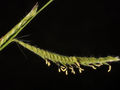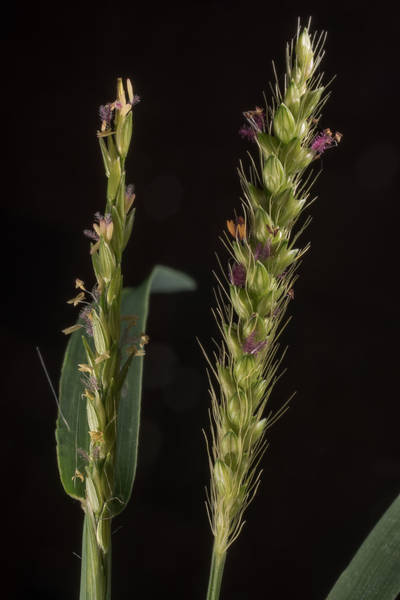

Digitaria grass (left) and small bristlegrass (Setaria) found on a lawn under live oaks in David E. Schob Nature Preserve at 906 Ashburn St. College Station, Texas


Album 2763: College Station, Texas, September 1 - 2, 2020
The image features two stalks of grass: **Digitaria** (left) and **Setaria**, also known as small bristlegrass (right). The Digitaria stem is slightly wider than that of Setaria, with a greenish-yellow hue and purple flowers at its tip. In contrast, the Setaria stem has a narrower diameter and features yellowish-orange buds.
Both stems are adorned with leaves near their bases, which are positioned on opposite sides of the stalks. The Digitaria leaf is long and thin, while the Setaria leaf is shorter and wider. The background of the image is dark, suggesting that it was taken at night or in a shaded area.
The image appears to have been captured using a camera with flash, as the flowers are illuminated from above. The overall effect is one of subtle contrast between the two grasses, highlighting their unique characteristics.
**Digitaria** and **Setaria** are both common lawn weeds found in many parts of North America. They can be identified by their distinctive flower colors and leaf shapes. Digitaria typically has purple flowers and long, thin leaves, while Setaria has yellowish-orange buds and shorter, wider leaves. – AI vision
🇪🇸 Descripción en español / Spanish Description
La hierba de la digitaria (izquierda) y la pequeña bistorta (Setaria) que se encuentran en un césped bajo robles vivos en el parque natural David E. Schob en 906 Ashburn Street. College Station, Texas, septiembre 1, 2020. La imagen presenta dos tallos de hierba: **Digitaria** (izquierda) y **Setaria**, también conocida como pequeña bistorta (derecha). El tallo de Digitaria es ligeramente más ancho que el de Setaria, con un tono amarillento-verdoso y flores moradas en su punta. Por el contrario, el tallo de Setaria tiene un diámetro más estrecho y presenta brotes amarillo-naranja. Ambos tallos están adornados con hojas cerca de sus bases, que se colocan en lados opuestos de los tallos. La hoja de Digitaria es larga y delgada, mientras que la hoja de Setaria es más corta y ancha. El fondo de la imagen es oscuro, lo que sugiere que se tomó de noche o en un área sombreada. Parece que la imagen se capturó usando una cámara con flash, ya que las flores están iluminadas desde arriba. El efecto general es el de un sutil contraste entre los dos tipos de hierba, resaltando sus características únicas. **Digitaria** y **Setaria** son ambas malas hierbas comunes que se encuentran en muchas partes de Norteamérica. Pueden identificarse por sus distintivas flores de colores y formas de hojas. Digitaria tiene flores moradas y hojas largas y delgadas, mientras que Setaria tiene brotes amarillo-naranja y hojas más cortas y anchas. – Spanish translation