
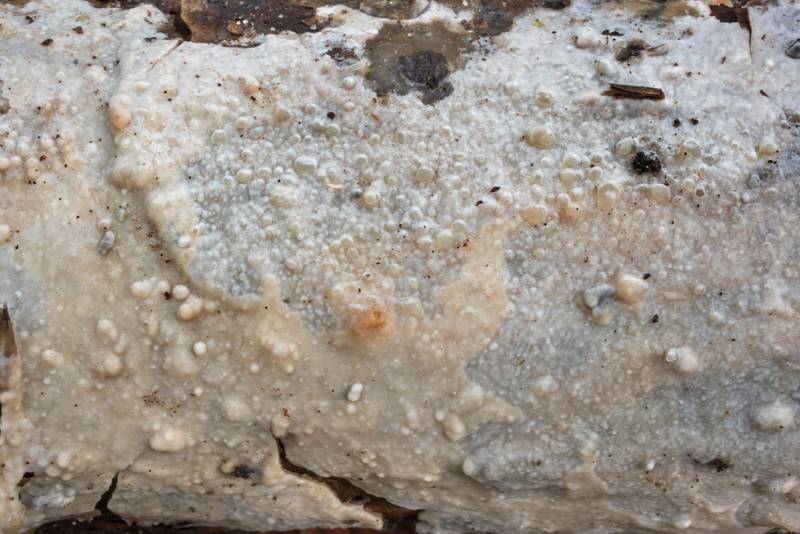

Corticioid (crust) fungus on thin bark of a fallen pine on Richards Loop Trail in Sam Houston National Forest. Texas


Album 2767: Sam Houston Forest - College Station, Texas, September 6 - 8, 2020
The provided image showcases a close-up view of a corticioid (crust) fungus growing on the bark of a fallen pine tree. The fungus covers much of the thin bark and has a white to light gray coloration with a slightly orange tint around its edges.
Corticioid fungi are characterized by their crust-like appearance, which can be seen in this image. They typically grow on decaying wood or other organic matter and play an important role in breaking down dead plant material. This process helps to recycle nutrients back into the soil, making them available for new plant growth.
Given that the fungus is growing on a fallen pine tree in Sam Houston National Forest, it's likely that this corticioid fungus has colonized the decaying wood and is helping to break it down. The image provides a detailed look at the fungus's appearance and texture, offering insight into its role in the forest ecosystem.
Overall, the image presents a fascinating example of the diverse range of organisms found in forests and their importance in maintaining ecological balance. – AI vision
🇪🇸 Descripción en español / Spanish Description
El hongo corticioide (costra) en la corteza delgada de un pino caído en el Richards Loop Trail en el Bosque Nacional Sam Houston. Texas, 6 de septiembre de 2020. La imagen proporcionada muestra una vista detallada de un hongo corticioide (costra) que crece en la corteza de un pino caído. El hongo cubre gran parte de la corteza delgada y tiene una coloración blanca a gris claro con un matiz ligeramente naranja alrededor de sus bordes. Los hongos corticioides se caracterizan por su apariencia similar a una costra, que puede verse en esta imagen. Por lo general, crecen en madera en descomposición u otra materia orgánica y desempeñan un papel importante en la descomposición de material vegetal muerto. Este proceso ayuda a reciclar nutrientes al suelo, haciéndolos disponibles para el crecimiento de nuevas plantas. Dado que el hongo está creciendo sobre un pino caído en el Bosque Nacional Sam Houston, es probable que este hongo corticioide haya colonizado la madera en descomposición y esté ayudando a descomponerla. La imagen proporciona una vista detallada del aspecto y textura del hongo, lo que ofrece información sobre su función en el ecosistema forestal. En general, la imagen presenta un fascinante ejemplo de la diversidad de organismos que se encuentran en los bosques y su importancia en el mantenimiento del equilibrio ecológico. – Spanish translation


