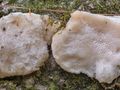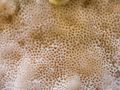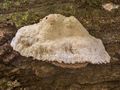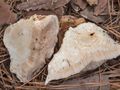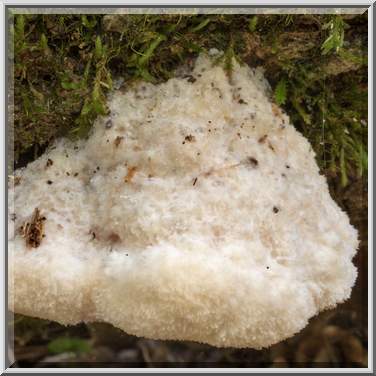
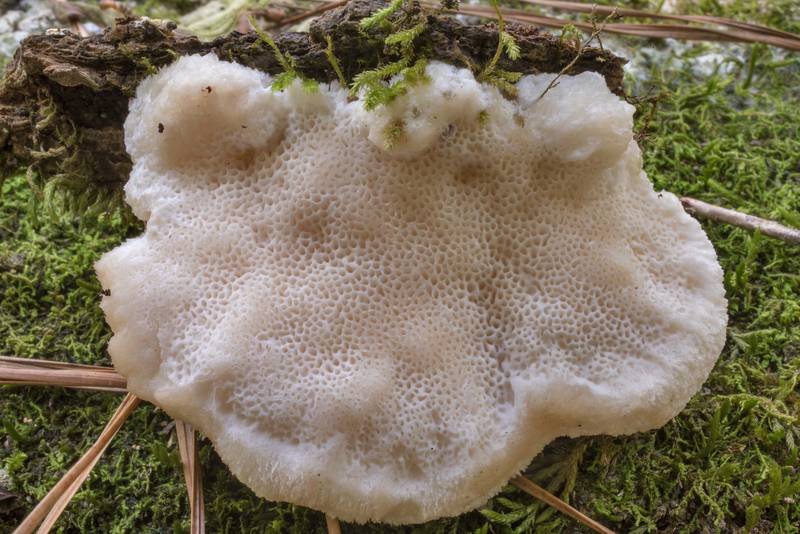
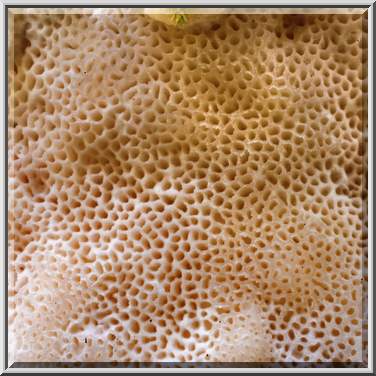
Underside of greasy bracket mushroom (Aurantiporus fissilis, Pappia fissilis) on a big fallen tree in Big Creek Scenic Area of Sam Houston National Forest. Shepherd, Texas


Album 2772: Big Creek Scenic Area of Sam Houston National Forest., Shepherd, Texas, September 12, 2020
The image depicts the underside of a Greasy Bracket mushroom (Aurantiporus fissilis, Pappia fissilis) growing on a large fallen tree branch situated within the Big Creek Scenic Area of Sam Houston National Forest in Shepherd, Texas.
Upon closer inspection, one can see that this bracket fungus has a unique appearance due to its irregular shape. The underside is characterized by numerous small pores, which are arranged in an intricate pattern. These pores play a crucial role in the mushroom's function, facilitating the exchange of nutrients and water between the organism and its environment.
The fungal structure exhibits a white coloration with a subtle brown hue at its center, providing a striking contrast to the surrounding mossy surface. This distinctive appearance is likely due to the presence of various pigments or substances within the mushroom's tissue that contribute to its overall aesthetic appeal.
In addition to its visual characteristics, the Greasy Bracket fungus also holds ecological significance. As a decomposer, it plays a vital role in breaking down organic matter and recycling nutrients back into the ecosystem, thereby contributing to the health and diversity of the forest environment.
Overall, this image offers a fascinating glimpse into the intricate world of fungi, highlighting not only their unique appearances but also their essential functions within the natural world. – AI vision
🇪🇸 Descripción en español / Spanish Description
El lado inferior de un hongo corchete grasiento (Aurantiporus fissilis, Pappia fissilis) en un gran árbol caído en el área escénica de Big Creek del Bosque Nacional Sam Houston. Shepherd, Texas, 12 de septiembre de 2020. La imagen representa la cara inferior de un hongo corchete grasiento (Aurantiporus fissilis, Pappia fissilis) que crece en un gran ramal de árbol caído situado dentro del área escénica de Big Creek del Bosque Nacional Sam Houston en Shepherd, Texas. Con una inspección más detallada, se puede observar que este hongo corchete tiene un aspecto único debido a su forma irregular. El lado inferior se caracteriza por numerosos poros pequeños, dispuestos en un patrón intrincado. Estos poros desempeñan un papel fundamental en la función del hongo, facilitando el intercambio de nutrientes y agua entre el organismo y su entorno. La estructura fúngica presenta una coloración blanca con un matiz marrón en su centro, lo que proporciona un contraste sorprendente con la superficie musgosa circundante. Este aspecto distintivo se debe probablemente a la presencia de diversos pigmentos o sustancias dentro del tejido del hongo que contribuyen a su apariencia estética general. Además de sus características visuales, el hongo corchete también es importante ecológicamente. Como descomponedor, desempeña un papel vital en la descomposición de materia orgánica y reciclar nutrientes de vuelta al ecosistema, contribuyendo así a la salud y diversidad del entorno forestal. En general, esta imagen ofrece una interesante visión del intrincado mundo de los hongos, destacando no solo sus aspectos únicos sino también sus funciones esenciales en el mundo natural. – Spanish translation