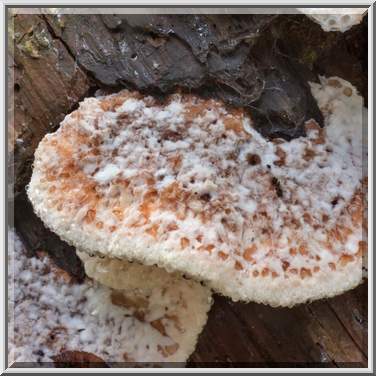
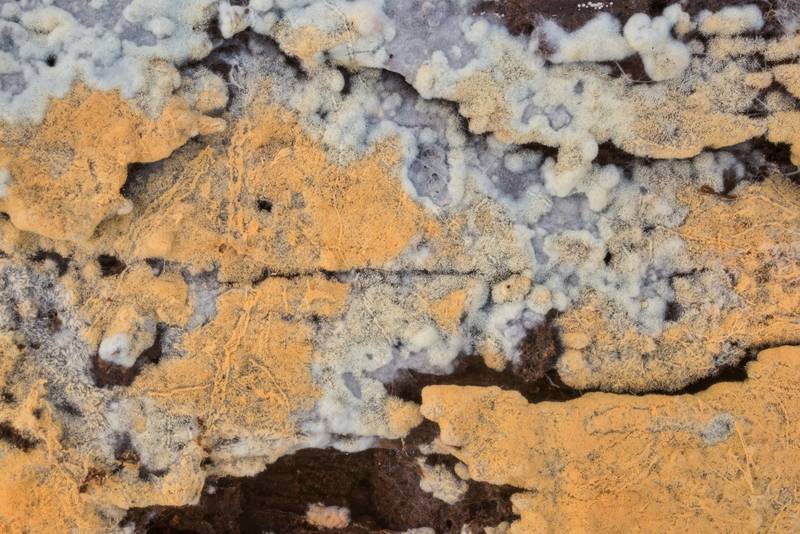

Corticioid fungus Botryobasidium robustius or may be B. aureum on a fallen pine or may be oak on Lone Star Hiking Trail south from Stubblefield Campground in Sam Houston National Forest. Montgomery, Texas


Album 2773: Sam Houston Forest, Texas, September 13, 2020
The image presents a close-up view of a corticioid fungus, specifically Botryobasidium robustius or possibly B. aureum, growing on a fallen tree trunk, likely either pine or oak, along the Lone Star Hiking Trail in Sam Houston National Forest, Montgomery, Texas.
**Visual Characteristics:**
* The fungus appears as a white and yellowish-brown growth covering most of the surface.
* It exhibits a rough, irregular texture with visible cracks and fissures.
* Some areas display a more powdery or granular appearance.
**Coloration:**
* The dominant color is a pale yellowish-brown hue, which may be due to the accumulation of spores or other substances on the surface.
* The white patches could indicate recent growth or an abundance of moisture in these regions.
**Growth Pattern:**
* The fungus tends to grow in irregularly shaped patches rather than forming uniform layers.
* Its distribution suggests a preference for certain microhabitats, possibly related to environmental conditions such as humidity or temperature gradients within the forest ecosystem.
**Overall Impression:**
* This image offers an intimate glimpse into the intricate world of fungi and their interactions with their environments.
* The detailed texture and coloration provide valuable insights into the biology and ecology of this particular species. – AI vision
🇪🇸 Descripción en español / Spanish Description
Un hongo corticío, Botryobasidium robustius o posiblemente B. aureum, en un pino caído o roble en el Lone Star Hiking Trail al sur del campamento Stubblefield en la Sam Houston National Forest. Montgomery, Texas, 13 de septiembre de 2020. La imagen muestra una vista de cerca de un hongo corticío, específicamente Botryobasidium robustius o posiblemente B. aureum, que crece en el tronco de un árbol caído, probablemente pino u oak, a lo largo del Lone Star Hiking Trail en Sam Houston National Forest, Montgomery, Texas. **Características visuales:** * El hongo aparece como un crecimiento blanco y amarillento-parduzco que cubre la mayor parte de la superficie. * Presenta una textura rugosa e irregular con grietas y fisuras visibles. * Algunas áreas muestran un aspecto más pulvurulento o granular. **Coloración:** * El color dominante es un tono amarillento-parduzco pálido, que puede deberse a la acumulación de esporas u otras sustancias en la superficie. * Los parches blancos podrían indicar un crecimiento reciente o una abundancia de humedad en estas zonas. **Patrón de crecimiento:** * El hongo tiende a crecer en parches con formas irregulares en lugar de formar capas uniformes. * Su distribución sugiere una preferencia por ciertos microhábitats, posiblemente relacionados con condiciones ambientales como la humedad o los gradientes de temperatura dentro del ecosistema forestal. **Impresión general:** * Esta imagen ofrece un vistazo a la intrincada vida de los hongos y sus interacciones con su entorno. * La textura detallada y la coloración proporcionan información valiosa sobre la biología y ecología de esta especie en particular. – Spanish translation


