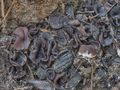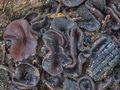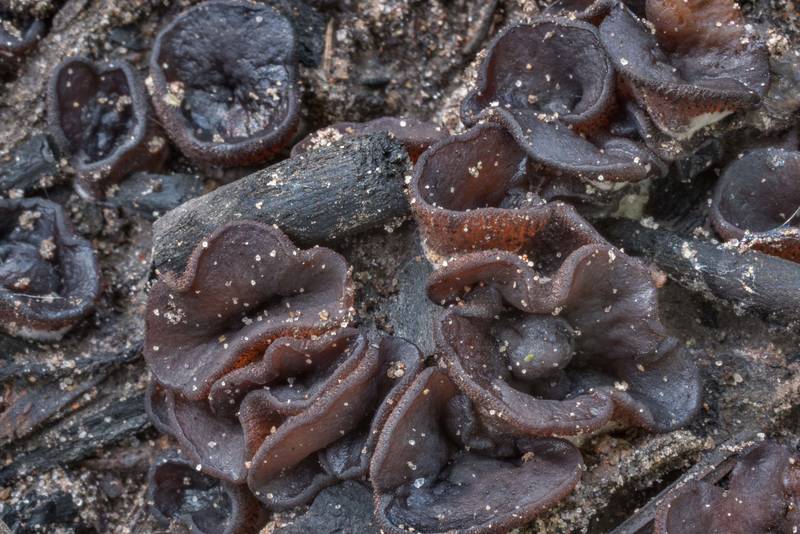

Close-up of Ascomycete mushrooms Ascobolus carbonarius on a bonfire site on Caney Creek Trail (Little Lake Creek Loop Trail) in Sam Houston National Forest north from Montgomery. Texas


Album 2780: Sam Houston Forest, Texas, September 19, 2020
The image shows close-up view of brownish-black Ascomycete mushrooms called Ascobolus carbonarius growing on a bonfire site, with an appearance that resembles small, dark-colored flowers or petals. The surface is covered with ash and soot from the fire.
**Key Features:**
* **Mushroom Appearance:** The mushroom has a brownish-black cap that appears to be made of thin, overlapping layers resembling petals or flower-like structures.
* **Size:** The size of the mushrooms varies but they are generally small to medium-sized.
* **Growing Conditions:** They seem to thrive in environments with high levels of ash and soot from fires.
* **Coloration:** The color of the mushroom is predominantly brownish-black, which may help it blend into its surroundings or protect it from environmental stressors.
**Overall Impression:**
The image suggests that Ascobolus carbonarius has adapted to survive in environments where other organisms might struggle due to the presence of ash and soot. This could be an example of a symbiotic relationship between the mushroom and the fire, with the mushroom possibly benefiting from the nutrients provided by the ash or using it as a protective shield against harmful microorganisms. – AI vision
🇪🇸 Descripción en español / Spanish Description
El siguiente texto debe traducirse del inglés al español:
Primer plano de los hongos Ascomycetes Ascobolus carbonarius en un lugar de hogueras en el sendero Caney Creek (sendero Little Lake Creek Loop) en el bosque nacional Sam Houston al norte de Montgomery. Texas, septiembre 19, 2020. La imagen muestra una vista detallada de los hongos Ascomycetes parduscos llamados Ascobolus carbonarius que crecen en un lugar de fuego, con un aspecto que se asemeja a pequeñas flores o pétalos de color oscuro. La superficie está cubierta de ceniza y polvo del fuego. **Características clave:** * **Aspeto del hongo:** El hongo tiene una tapa pardusca que parece estar hecha de capas finas superpuestas que se asemejan a estructuras similares a pétalos o similares a flores. * **Tamaño:** El tamaño de los hongos varía, pero son generalmente pequeños a de tamaño mediano. * **Condiciones de crecimiento:** Ellos parecen prosperar en entornos con altos niveles de ceniza y polvo de fuego. * **Coloración:** El color del hongo es predominantemente pardusco, lo que puede ayudarlo a mezclarse con sus alrededores o protegerlo de estresores ambientales. **Impresión general:** La imagen sugiere que Ascobolus carbonarius se ha adaptado para sobrevivir en entornos donde otros organismos podrían tener dificultades debido a la presencia de ceniza y polvo. Esto podría ser un ejemplo de una relación simbiótica entre el hongo y el fuego, con el hongo posiblemente beneficiándose de los nutrientes proporcionados por la ceniza o usando estos como escudo protector contra microorganismos nocivos. – Spanish translation