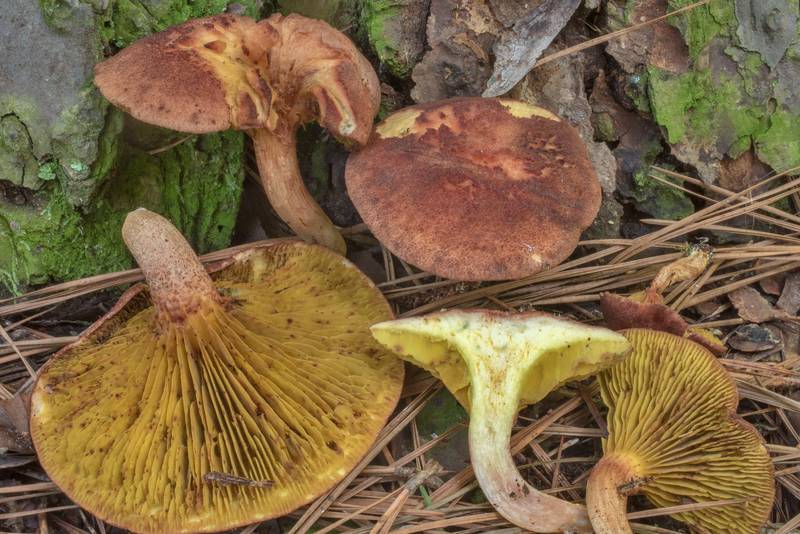

Cross section of gilled Bolete mushrooms (Phylloporus leucomycelinus) at the base of a pine tree on Caney Creek Trail (Little Lake Creek Loop Trail) in Sam Houston National Forest north from Montgomery. Texas


Album 2792: Mushrooms in Sam Houston Forest, Texas, September 26, 2020
The image presents a close-up view of several Bolete mushrooms growing at the base of a pine tree on Caney Creek Trail in Sam Houston National Forest. The mushrooms exhibit distinctive features that distinguish them from other types of fungi.
**Mushroom Characteristics**
* **Cap**: The caps are rounded and flat, with smooth, brownish-yellow surfaces featuring some darker spots.
* **Stem**: The stems are long and thin, tapering towards the base, and have a hollow interior.
* **Gills**: The gills are white and run down the stem, becoming more crowded towards the cap's edge.
**Background**
The background of the image consists mainly of pine needles, indicating that the mushrooms are growing in a forest environment. This is consistent with their typical habitat, as Bolete mushrooms often thrive in association with coniferous trees like pines.
**Overall Impression**
The image provides an intimate look at the intricate details of these fascinating fungi, highlighting their unique characteristics and ecological niche. – AI vision
🇪🇸 Descripción en español / Spanish Description
Una sección transversal de hongos Bolete (Phylloporus leucomycelinus) con esporas en la base de un pino en el Caney Creek Trail (Little Lake Creek Loop Trail) en Sam Houston National Forest al norte de Montgomery, Texas, el 26 de septiembre de 2020. La imagen presenta una vista detallada de varios hongos Bolete creciendo en la base de un pino en el Caney Creek Trail en Sam Houston National Forest. Los hongos muestran características distintivas que los distinguen de otros tipos de hongos. **Características del Hongo** * **Sombrero**: El sombrero es redondo y plano, con superficies marrones oscuras lisas que presentan manchas más oscuras. * **Tallo**: Los tallos son largos y delgados, estrechándose hacia la base, y tienen un interior hueco. * **Garras**: Las garras son blancas y corren por el tallo, ensanchándose hacia el borde del sombrero. **Antecedentes** El fondo de la imagen consiste principalmente en agujas de pino, lo que indica que los hongos están creciendo en un entorno forestal. Esto es coherente con su hábitat típico, ya que los hongos Bolete a menudo prosperan en asociación con árboles coníferos como pinos. **Impresión General** La imagen proporciona una mirada íntima a los detalles intrincados de estos fascinantes hongos, resaltando sus características únicas y su nicho ecológico. – Spanish translation