 |
| |||||||||||||||||

| ||||||||||||||||||


| Similar |   |
  |
  |
  |
  |
| |||||||||||||||||||||||||||||
| |||||||||||||||||||||||||||||
| 1996 1997 1998 1999 2000 2001 2002 2003 2004 2005 2006 2007 2008 2009 2010 2011 2012 2013 2014 2015 2016 2017 2018 2019 2020 2021 2022 2023 2024 2025 2026 | |||||||||||||||||||||||||||||
| New version Slide Show Most Popular Full List Statistics Technical Details Home Page | |||||||||||||||||||||||||||||
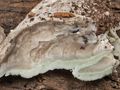
The smoky-headed cheese fungus (Tyromyces fumidiceps) boasts minute pores on an oak log lacking bark in a dry creek along the Caney Creek section of the Lone Star Hiking Trail in Sam Houston National Forest, located north of Montgomery, Texas. This photograph was captured on October 10, 2020. – generated by AI |
The provided image displays a close-up view of the underside of an oak log devoid of its bark, revealing an intricate pattern of pores that cover nearly all visible surfaces. The pores are densely packed and appear to be tiny tubes or holes, ranging from 0.5mm to 1mm in diameter. These pores give rise to a variety of colors as they extend through the wood, including white, light tan, light brown, dark yellow-brown, dark brown, and black. The pores on the surface are more numerous than those extending into the wood, potentially indicating that this is one of the earliest stages of fruiting body formation. The pores' small size suggests that these may be primordial pore tubes rather than mature ones. Furthermore, the lack of a distinct hymenium (the spore-bearing layer) or gills on the surface implies that this log has not yet produced any fully developed mushrooms. The image also reveals numerous black dots and specks scattered throughout the pores. These could potentially represent insect parts, such as exoskeletons from beetles or ants, which are common inhabitants of decaying wood. Alternatively, these might be fungal spores, possibly belonging to a different species that has colonized the same log. Overall, this image presents an intriguing snapshot of the early stages of mycelial growth and development in a decaying oak log, offering valuable insights into the complex processes involved in mushroom formation. – AI vision |
Tiny poros del hongo queso negruzco (Tyromyces fumidiceps) en un tronco de roble (?) sin corteza en un arroyo seco en la sección de Caney Creek del Sendero de excursiones Lone Star en el Bosque Nacional Sam Houston al norte de Montgomery. Texas, 10 de octubre de 2020. La imagen proporcionada muestra una vista cercana de la parte inferior de un tronco de roble desprovisto de corteza, que revela un patrón intrincado de poros que cubren casi todas las superficies visibles. Los poros están densamente empaquetados y parecen ser tubos o agujeros minúsculos, con un diámetro que oscila entre 0.5 mm y 1 mm. Estos poros dan lugar a una variedad de colores a medida que se extienden a través de la madera, incluyendo blanco, marrón claro, marrón claro, amarillo-marrón oscuro, marrón oscuro y negro. Los poros en la superficie son más numerosos que aquellos que se extienden hacia adentro de la madera, lo que podría indicar que ésta es una de las primeras etapas de formación del cuerpo fructífero. El pequeño tamaño de los poros sugiere que éstos pueden ser tubos primordiales en lugar de maduros. Además, la falta de un himenio distintivo (la capa que lleva las esporas) o de láminas en la superficie implica que este tronco aún no ha producido hongos completamente desarrollados. La imagen también revela numerosos puntos y manchas negros dispersos por los poros. Estos podrían representar partes de insectos, tales como exoesqueletos de escarabajos o hormigas, que son comunes habitantes de la madera en descomposición. Como alternativa, esto podría ser esporas fúngicas, posiblemente pertenecientes a una especie diferente que ha colonizado el mismo tronco. En general, esta imagen presenta un interesante instantánea de las primeras etapas del crecimiento y desarrollo micelial en un tronco en descomposición de roble, ofreciendo valiosos conocimientos sobre los complejos procesos implicados en la formación de hongos. – Spanish translation |
| [+] | dry creek | |
| [+] | oak bark |
Keyword variants
high resolution online digital collection
Star Hiking Trail pictures
Houston National Forest grafika
Lone Star State
United States
picture gallery
photo album
documentary photographs
daily pics
TX
travelogue
snapshots
sightseeing
photowalks
photoblog
graphic
fotografias
foto
America