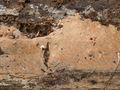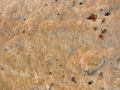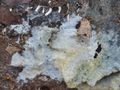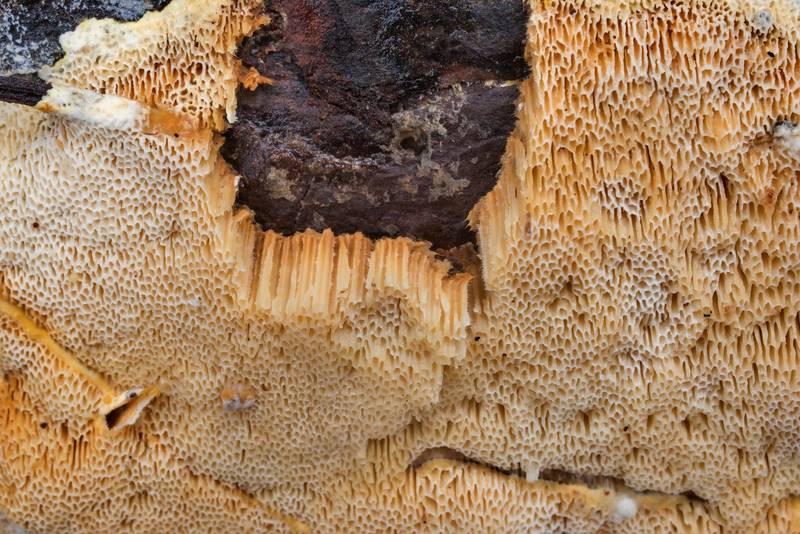

Light brown layer of resupinate polypore mushroom on pine bark on Caney Creek section of Lone Star Hiking Trail in Sam Houston National Forest north from Montgomery. Texas


Album 2833: Sam Houston Forest, Texas, December 20, 2020
This image presents a detailed close-up view of a light brown layer of resupinate polypore mushroom on pine bark, captured in a forest setting.
The background of the image features a dark brown color, which is likely the surface of the tree trunk or log where the fungus has colonized. The foreground area showcases a layer of light-brown tissue that appears to be growing out from the bark of a pine tree. This layer is characterized by its resupinate growth habit, meaning it grows flat against the substrate rather than forming upright structures.
Upon closer inspection, one can observe small pores or tubes on the surface of this fungus, which are typical features of resupinate polypores. These structures play a crucial role in the fungus's ability to absorb nutrients from its surroundings. The overall appearance suggests that the fungus is thriving in its environment and has formed a dense layer of tissue as it grows.
The image provides an intimate look at the intricate details of this fascinating organism, highlighting its unique growth pattern and structural features. – AI vision
🇪🇸 Descripción en español / Spanish Description
Una capa marrón claro de hongos poliporos resupinados en corteza de pino en la sección de Caney Creek del Sendero de Excursiones Lone Star en el Bosque Nacional Sam Houston al norte de Montgomery, Texas, el 20 de diciembre de 2020. Esta imagen presenta una vista detallada y próxima de una capa marrón claro de hongos poliporos resupinados en corteza de pino, capturada en un entorno forestal. El fondo de la imagen presenta un color marrón oscuro, que es probablemente la superficie del tronco o la madera donde ha colonizado el hongo. La zona del primer plano muestra una capa de tejido marrón claro que parece estar creciendo desde la corteza de un árbol de pino. Esta capa se caracteriza por su hábitat de crecimiento resupinado, lo que significa que crece plano contra el sustrato en lugar de formar estructuras erectas. Al observarlo con más detalle, uno puede observar pequeños poros o tubos en la superficie del hongo, que son características típicas de los hongos poliporos resupinados. Estas estructuras desempeñan un papel crucial en la capacidad del hongo para absorber nutrientes de su entorno. La apariencia general sugiere que el hongo está prosperando en su medio ambiente y ha formado una densa capa de tejido a medida que crece. La imagen proporciona un vistazo íntimo a los detalles intrincados de este organismo fascinante, destacando su patrón de crecimiento único y sus características estructurales. – Spanish translation