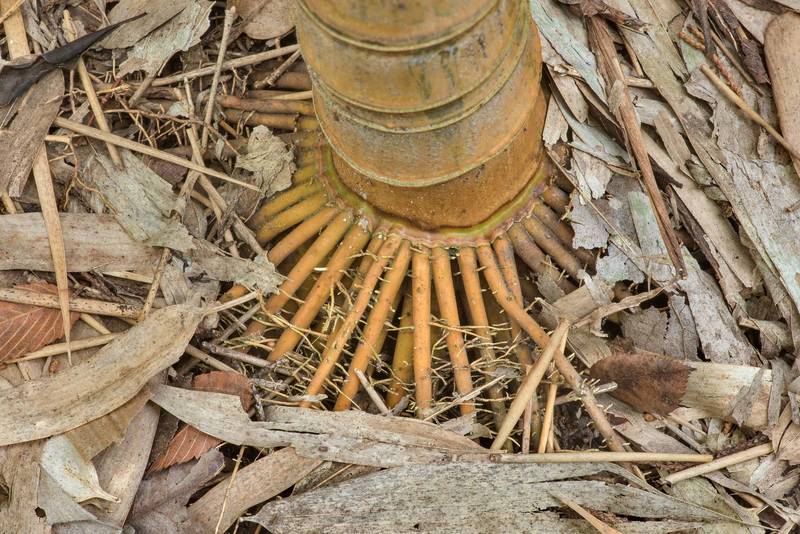

Roots at the base of giant cane (Arundinaria gigantea) on Kiwanis Nature Trail. College Station, Texas


Album 2845: Sam Houston Forest, Texas, January 5 - 9, 2021
The image presents a detailed view of the roots at the base of a giant cane plant situated on the Kiwanis Nature Trail in College Station, Texas. The photograph is oriented vertically and appears to have been taken from a low angle, likely while lying down or crouching.
In the foreground, the plant's trunk dominates the scene. A brownish-yellow ring surrounds the base of the trunk, which is made up of several layers that are slightly separated from one another. This structure may be a product of the plant's growth pattern or possibly a feature created by some external factor. The lower portion of the trunk is encircled by multiple thick, yellow roots that extend outward like fingers. These roots are covered in fine hairs and appear to be anchored deep within the ground.
The background of the image consists of dried leaves and twigs scattered throughout the area around the plant's base. This suggests that the photograph was taken during a dry season or after a period of cold weather, as some trees shed their leaves during these times.
Overall, the image provides a unique perspective on the intricate details of giant cane plants and their ability to thrive in various environments. – AI vision
🇪🇸 Descripción en español / Spanish Description
Las raíces de la base del cañón gigante (Arundinaria gigantea) en el sendero natural Kiwanis. College Station, Texas, 6 de enero de 2021. La imagen presenta una vista detallada de las raíces en la base de una planta de caña gigante situada en el Sendero Natural Kiwanis en College Station, Texas. La fotografía está orientada verticalmente y parece haberse tomado desde un ángulo bajo, probablemente mientras se acostaba o agachaba. En primer plano, el tronco de la planta domina la escena. Un anillo marrón amarillento rodea la base del tronco, que está compuesto por varias capas ligeramente separadas entre sí. Esta estructura puede ser un producto del patrón de crecimiento de la planta o posiblemente una característica creada por algún factor externo. La parte inferior del tronco está rodeada por múltiples raíces amarillas gruesas que se extienden hacia afuera como dedos. Estas raíces están cubiertas de pelillos finos y parecen estar ancladas profundamente en el suelo. El fondo de la imagen consiste en hojas secas y ramitas esparcidas por toda la zona alrededor de la base de la planta. Esto sugiere que la fotografía fue tomada durante una estación seca o después de un periodo de tiempo frío, ya que algunos árboles pierden sus hojas durante estos tiempos. En general, la imagen proporciona una perspectiva única sobre los detalles intrincados de las plantas de caña gigante y su capacidad para prosperar en varios entornos. – Spanish translation