
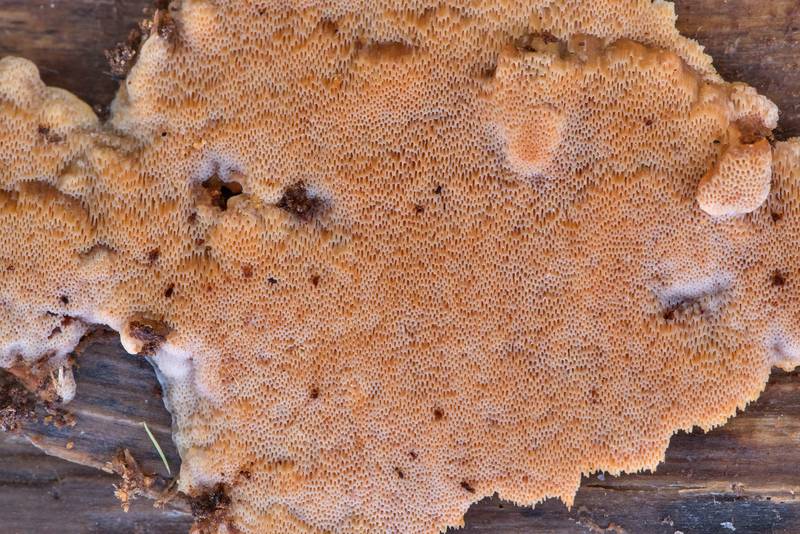

Texture of brown resupinate polypore mushroom detached from a lower surface of a large pine log in Big Creek Scenic Area of Sam Houston National Forest. Shepherd, Texas


Album 2850: College Station - Sam Houston Forest, Texas, January 15 - 16, 2021
This image presents a detailed view of the underside of a large pine log that has been colonized by a resupinate polypore mushroom (a type of bracket fungus). The photograph was captured on January 16, 2021, in Big Creek Scenic Area, Sam Houston National Forest.
**Key Features:**
* **Texture and Color:** The surface of the log exhibits a range of brown hues, transitioning from light beige to dark brown. The mushroom's texture is characterized by a rough, porous appearance.
* **Growth Pattern:** The resupinate polypore has grown in a flat, plate-like manner on top of the pine log. This growth pattern allows it to cover more surface area and absorb nutrients from its surroundings efficiently.
* **Attachment Points:** The mushroom's underside displays several dark brown spots with small holes at their centers. These attachment points suggest that the fungus has formed connections with the underlying wood tissue, facilitating nutrient exchange.
**Overall Impression:**
The image provides an intimate look at the intricate details of a resupinate polypore mushroom and its interaction with its host substrate (the pine log). The photograph highlights the complex relationships between fungi and their environment, showcasing the fascinating world of mycology. – AI vision
🇪🇸 Descripción en español / Spanish Description
Textura del hongo resupinado poliporo marrón desprendido de una superficie inferior de un tronco de pino grande en el área panorámica de Big Creek del bosque nacional Sam Houston. Shepherd, Texas, 16 de enero de 2021. Esta imagen presenta una vista detallada de la parte inferior de un tronco de pino que ha sido colonizado por un hongo resupinado poliporo (un tipo de hongo en forma de consola). La fotografía fue capturada el 16 de enero de 2021, en el área panorámica de Big Creek, bosque nacional Sam Houston. *Características clave:* *Textura y color: *La superficie del tronco presenta una gama de matices marrones, que transitan desde un beige claro a un marrón oscuro. La textura del hongo se caracteriza por una apariencia áspera y porosa. *Patrón de crecimiento: *El poliporo resupinado ha crecido de manera plana, a modo de placas, en la parte superior del tronco de pino. Este patrón de crecimiento le permite cubrir una superficie mayor y absorber eficientemente los nutrientes de su entorno. *Puntos de unión: *El lado inferior del hongo presenta varias manchas marrones oscuras con pequeños agujeros en el centro. Estos puntos sugieren que el hongo ha formado conexiones con el tejido de la madera subyacente, facilitando el intercambio de nutrientes. *Impresión general: *La imagen ofrece una mirada cercana a los detalles intrincados del hongo resupinado poliporo marrón y su interacción con su sustrato anfitrión (el tronco de pino). La fotografía destaca las complejas relaciones entre los hongos y su entorno, mostrando el fascinante mundo de la micología. – Spanish translation


