
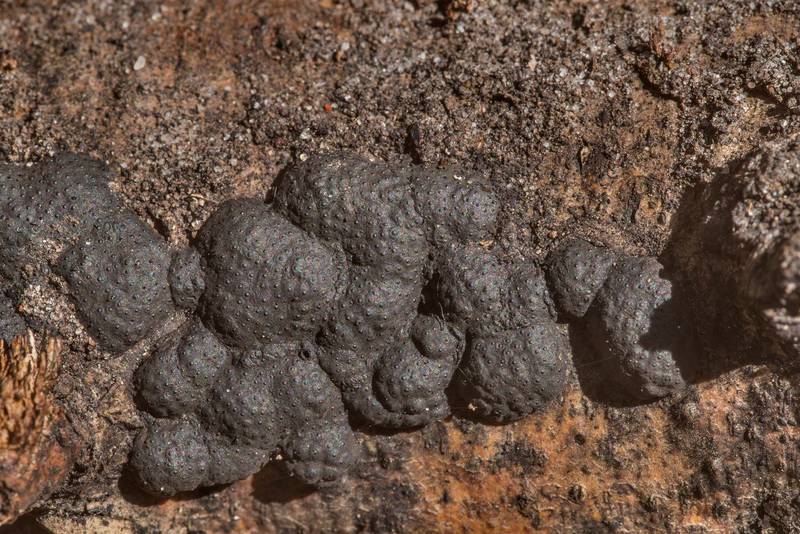

Details of beech woodwart fungus (Hypoxylon fragiforme) on a fallen twig on Caney Creek Trail (Little Lake Creek Loop Trail) in Sam Houston National Forest north from Montgomery. Texas


Album 2877: Sam Houston Forest, Texas, March 7, 2021
The image captures a close-up view of a beech woodwart fungus growing on a fallen twig in Caney Creek Trail within the Little Lake Creek Loop Trail in Sam Houston National Forest.
In the center of the image is an irregularly shaped cluster of dark gray to black fungal growths that resemble small, lumpy balls. They are roughly spherical and appear to have been eroded by weathering or mechanical damage. The fungus grows on a fallen twig lying on top of a bed of brownish soil with bits of bark visible.
The background features the surrounding area, which is covered in a layer of dark gray to black spores produced by the fungus. This is consistent with the habitat and life cycle of beech woodwart, as it typically thrives on dead or dying trees.
Overall, the image provides a detailed view of the beech woodwart fungus growing on a fallen twig in its natural habitat. The close-up perspective allows for observation of the fungal growths' texture and coloration, offering insight into the species' characteristics and behavior. – AI vision
🇪🇸 Descripción en español / Spanish Description
Detalles del hongo de madera Hypoxylon fragiforme en una rama caída en el Caney Creek Trail (Little Lake Creek Loop Trail) en el Bosque Nacional Sam Houston al norte de Montgomery, Texas, 7 de marzo de 2021. La imagen muestra una vista detallada del hongo de madera de haya que crece en una rama caída en Caney Creek Trail dentro del Little Lake Creek Loop Trail en el Bosque Nacional Sam Houston. En el centro de la imagen se puede ver un grupo irregularmente conformado de crecimientos fúngicos grises oscuros a negros, que recuerdan a pelotas pequeñas y con bultos. Son más o menos esféricos y parecen haberse erosionado debido al desgaste o daño mecánico. El hongo crece en una rama caída tendida sobre un lecho de tierra parduzca con trozos de corteza visible. En el fondo se puede ver la zona circundante, cubierta por una capa de esporas grises oscuras a negras producidas por el hongo. Esto es característico del hábitat y del ciclo vital del hongo de madera de haya, que generalmente crece en árboles muertos o en proceso de muerte. En general, la imagen ofrece una vista detallada del hongo de madera Hypoxylon fragiforme que crece en una rama caída en su hábitat natural. La perspectiva cercana permite observar la textura y el color del crecimiento fúngico, lo cual ofrece información sobre las características y conductas de esta especie. – Spanish translation


