
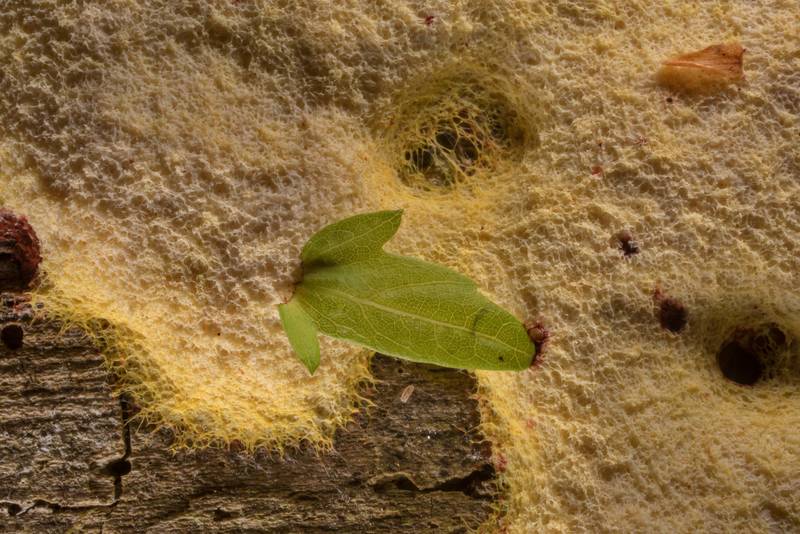

Dog Vomit Slime Mold (Fuligo septica) on an oak log on Caney Creek Trail (Little Lake Creek Loop Trail) in Sam Houston National Forest north from Montgomery. Texas


Album 2902: Bryan - Sam Houston Forest, Texas, April 6 - 10, 2021
This photograph captures a captivating scene of Dog Vomit Slime Mold (Fuligo septica) on an oak log situated along Caney Creek Trail within Sam Houston National Forest north of Montgomery, Texas.
The vibrant yellow-orange slime mold covers a significant portion of the log's surface, which appears to be weathered and rough. The mold forms soft, fuzzy patches that are reminiscent of its common name, "Dog Vomit Slime Mold." In this image, some of these patches have grown together to create a large, flat expanse.
A few leaves rest on top of the slime mold, adding a touch of natural beauty to the scene. One leaf in particular stands out due to its bright green color and long shape, resembling an elongated teardrop with pointed ends. The surrounding environment is characterized by a mix of brown and tan hues, which are typical colors found in forest floors.
Overall, this image showcases the unique characteristics of Dog Vomit Slime Mold as it thrives on the oak log, creating a fascinating display of nature's diversity. – AI vision
🇪🇸 Descripción en español / Spanish Description
Molda de la Siempre Vomita de los Perros (Fuligo septica) en un tronco de roble en el Camino del Arroyo Caney (Camino del Bucle del Arroyo Little Lake) en el Bosque Nacional Sam Houston al norte de Montgomery. Texas, 10 de abril de 2021. Esta fotografía captura una escena cautivadora del Molda de la Siempre Vomita de los Perros (Fuligo septica) en un tronco de roble situado a lo largo del Camino del Arroyo Caney dentro del Bosque Nacional Sam Houston al norte de Montgomery, Texas. El vibrante moho amarillo naranja cubre una parte significativa de la superficie del tronco, que parece estar desgastada y áspera. El moho forma manchas suaves y peludas que recuerdan a su nombre común, "Molda de Siempre Vomita de los Perros." En esta imagen, algunas de estas manchas han crecido juntas para crear una gran extensión plana. Algunas hojas descansan encima del moho, añadiendo un toque de belleza natural a la escena. Una hoja en particular destaca debido a su color verde brillante y forma alargada, pareciéndose a una gota de lágrimas alargada con extremos puntiagudos. El entorno circundante se caracteriza por una mezcla de tonalidades marrones y tierra, que son colores típicos encontrados en suelos forestales. En general, esta imagen muestra las características únicas del Molda de la Siempre Vomita de los Perros a medida que prospera sobre el tronco de roble, creando una exhibición fascinante de la diversidad de la naturaleza. – Spanish translation


