
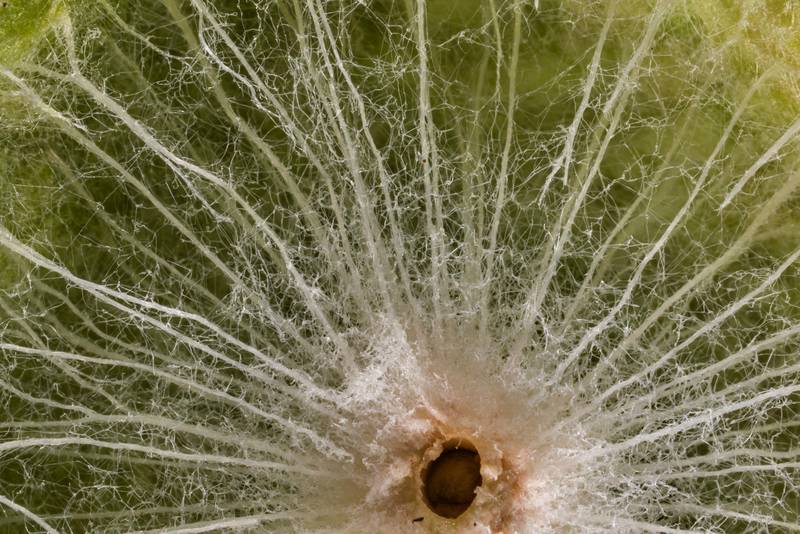

Cross section of an oak gall on Caney Creek Trail (Little Lake Creek Loop Trail) in Sam Houston National Forest north from Montgomery. Texas


Album 2903: Sam Houston Forest, Texas, April 10, 2021
The image depicts a cross-section of an oak gall, showcasing its intricate structure and internal features. The gall is primarily composed of white, fibrous material resembling roots or threads that radiate from the center towards the edges. This structure suggests that the gall has been formed by some kind of insect or other organism.
At the center of the image, a small, dark brown opening is visible, which appears to be an entrance to the gall's interior. The surrounding area is characterized by a light greenish-yellow hue, indicating the presence of plant material.
The overall appearance of the oak gall suggests that it has been formed as a result of some kind of biological interaction between the oak tree and another organism, possibly an insect or fungus. The exact nature of this interaction is not immediately clear from the image alone, but it is likely related to the production of chemicals by the insect or other organism that stimulate the growth of plant tissue within the gall.
In summary, the image provides a detailed view of the internal structure of an oak gall, highlighting its unique features and suggesting a complex biological process underlying its formation. – AI vision
🇪🇸 Descripción en español / Spanish Description
Una sección transversal de una agalla de roble en el Sendero Caney Creek (Sendero del Bucle del Río Little Lake) en la Sam Houston National Forest al norte de Montgomery, Texas, el 10 de abril de 2021. La imagen muestra una sección transversal de una agalla de roble, mostrando su estructura intrincada y características internas. La agalla está compuesta principalmente por material fibroso blanco que se asemeja a raíces o hebras que salen del centro hacia los bordes. Esta estructura sugiere que la agalla ha sido formada por algún tipo de insecto u otro organismo. En el centro de la imagen, es visible una pequeña abertura marrón oscuro, que parece ser la entrada al interior de la agalla. El área circundante tiene un tono verdoso-amarillento claro, lo que indica la presencia de material vegetal. La apariencia general de la agalla sugiere que se ha formado como resultado de algún tipo de interacción biológica entre el roble y otro organismo, posiblemente un insecto o hongo. La naturaleza exacta de esta interacción no está clara a partir de la imagen sola, pero es probable que esté relacionada con la producción de productos químicos por parte del insecto u otro organismo que estimulan el crecimiento de tejido vegetal dentro de la agalla. En resumen, la imagen proporciona una vista detallada de la estructura interna de una agalla de roble, destacando sus características únicas y sugerir un proceso biológico complejo subyacente a su formación. – Spanish translation


