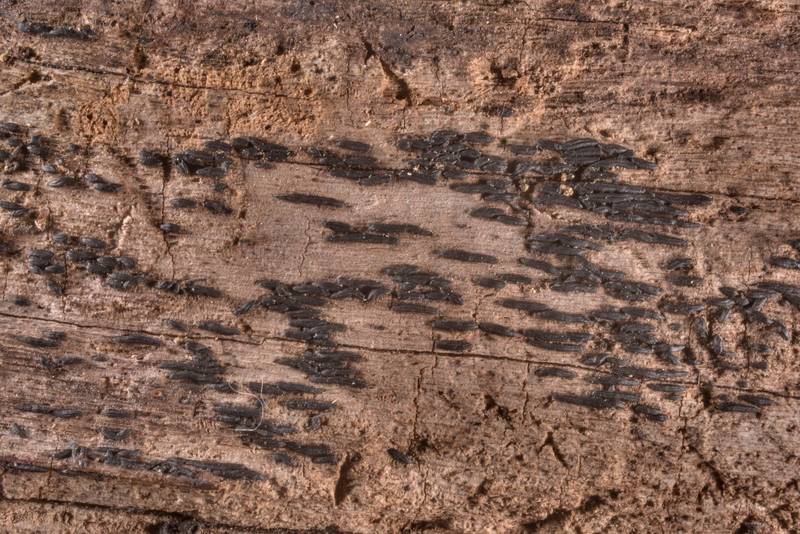
Black Hysteroid pyrenomycetous fungi Hysterium angustatum(?) on an old dead osage orange (Maclura) tree in Washington-on-the-Brazos State Historic Site. Washington, Texas


Album 2914: Sam Houston Forest - Washington, Texas, April 18 - 19, 2021
The image depicts a close-up view of an old dead osage orange (Maclura) tree, with black Hysteroid pyrenomycetous fungi, specifically Hysterium angustatum(?), visible on its surface.
**Tree Characteristics:**
* The tree appears to be quite aged and weathered.
* Its bark is rough and cracked, with deep grooves running along the trunk.
* The wood grain is visible through the cracks in the bark, indicating that the tree has lost some of its outer layer over time.
**Fungal Growth:**
* The black Hysteroid pyrenomycetous fungi are scattered across the surface of the tree, particularly on the exposed areas where the bark has cracked or fallen off.
* The fungi appear as small, dark spots or patches that vary in size and shape.
* Some of the fungal growths have a distinctive "spore" or "pustule" appearance, which is typical for this type of fungus.
**Environmental Context:**
* The tree is located in Washington-on-the-Brazos State Historic Site, suggesting that it has been present in this area for an extended period.
* The presence of Hysterium angustatum(?) on the tree implies a humid and temperate climate, as these fungi typically thrive in such conditions.
**Overall Impression:**
The image provides a fascinating glimpse into the intricate relationships between trees, fungi, and their environment. It highlights the importance of preserving old-growth forests like Washington-on-the-Brazos State Historic Site, which serve as natural laboratories for studying ecological processes and biodiversity. – AI vision
🇪🇸 Descripción en español / Spanish Description
Los hongos pirenomycetosos Hysteroides negros Hysterium angustatum(?) en un naranjo americano muerto viejo (Maclura) en el sitio histórico del estado de Washington-en-el-Brazos. Washington, Texas, 19 de abril de 2021. La imagen representa una vista detallada de un naranjo americano muerto viejo, con hongos pirenomycetosos negros Hysteroides, específicamente Hysterium angustatum(?), visibles en su superficie. **Características del árbol:** * El árbol parece estar muy envejecido y desgastado. * Su corteza es rugosa y agrietada, con surcos profundos que discurren a lo largo del tronco. * La textura de la madera es visible a través de las grietas de la corteza, lo que indica que el árbol ha perdido parte de su capa externa con el tiempo. **Crecimiento fúngico:** * Los hongos pirenomycetosos negros se dispersan por toda la superficie del árbol, particularmente en las áreas expuestas donde la corteza se ha agrietado o caído. * Los hongos aparecen como pequeñas manchas oscuras o parches que varían en tamaño y forma. * Algunos de los crecimientos fúngicos tienen un aspecto distintivo de "espora" o "pústula", lo que es típico para este tipo de hongos. **Contexto ambiental:** * El árbol está ubicado en el sitio histórico del estado de Washington-en-el-Brazos, lo que sugiere que ha estado presente en esta área durante un período prolongado. * La presencia de Hysterium angustatum(?) en el árbol implica un clima húmedo y templado, ya que estos hongos suelen prosperar en tales condiciones. **Impresión general:** La imagen proporciona una fascinante perspectiva de las relaciones complejas entre los árboles, los hongos y su entorno. Destaca la importancia de preservar los bosques viejos como el sitio histórico del estado de Washington-en-el-Brazos, que sirven como laboratorios naturales para estudiar procesos ecológicos y biodiversidad. – Spanish translation