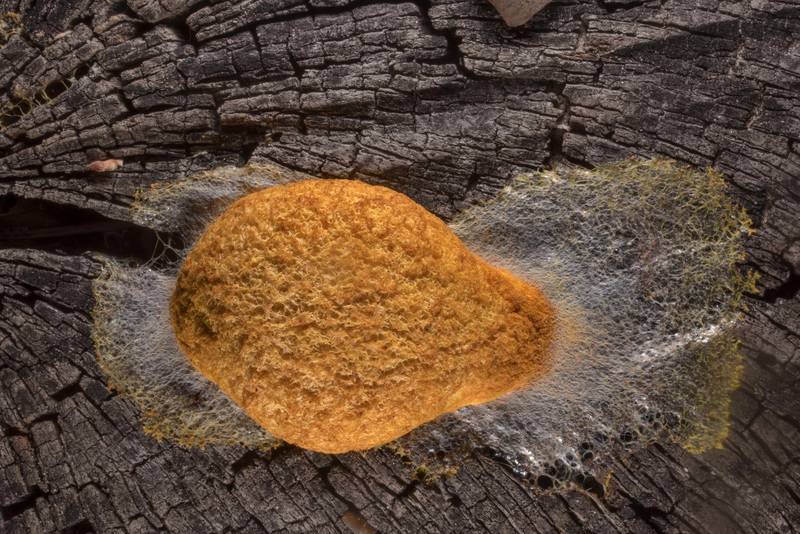

Some golden slime mold in a mature stage on a tree stump in Wolf Pen Creek Park. College Station, Texas


Album 2919: Bastrop - College Station, Texas, April 25 - 28, 2021
The image showcases a vibrant yellow-orange slime mold, likely in its mature stage, growing on an aged tree stump situated in Wolf Pen Creek Park, College Station, Texas. The focal point of the photograph is the slimy mass of golden-yellow material, which appears to have grown into irregular shapes with distinct ridges and valleys.
The surrounding area is covered by a grayish-white fungus that has likely formed naturally in the environment. This fungal growth may be contributing to the decomposition process of the tree stump or could be competing for resources alongside the slime mold.
In the background of this photograph, we can see a dark brown or black tree stump with deep grooves and cracks on its surface. The bark is rough and weathered, indicating that it has been exposed to the elements for some time. Some patches of moss are also visible in the crevices of the tree trunk.
The overall atmosphere of this image suggests a warm, humid environment with abundant moisture, which would be conducive to the growth of both slime molds and fungi. The presence of these organisms on the decaying tree stump highlights their role in breaking down organic matter and recycling nutrients back into the ecosystem. – AI vision
🇪🇸 Descripción en español / Spanish Description
Un hongo de limo dorado maduro sobre un tronco en el Wolf Pen Creek Park. College Station, Texas, 27 de abril de 2021. La imagen muestra un hongo de limo amarillo-naranja vibrante, probablemente en su etapa madura, creciendo sobre un tronco viejo situado en el Wolf Pen Creek Park, College Station, Texas. El punto focal de la fotografía es la masa viscosa de material dorado-amarillento, que parece haber crecido en formas irregulares con aristas y valles distintivos. La zona circundante está cubierta por un hongo blanquecino grisáceo que se ha formado de manera natural en el entorno. Este crecimiento fúngico puede estar contribuyendo al proceso de descomposición del tronco viejo o podría estar compitiendo por recursos junto con el hongo de limo. En segundo plano, podemos ver un tronco oscuro marrón o negro con surcos y grietas profundos en su superficie. La corteza es áspera y desgastada, lo que indica que ha estado expuesta a los elementos durante algún tiempo. También son visibles parches de musgo en las hendiduras del tronco del árbol. El ambiente global de esta imagen sugiere un clima cálido y húmedo con una abundancia de humedad, lo que sería beneficioso para el crecimiento tanto de mohos como de hongos. La presencia de estos organismos en el tronco viejo resalta su función en la descomposición de la materia orgánica y en el reciclaje de nutrientes hacia el ecosistema. – Spanish translation