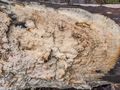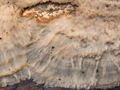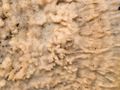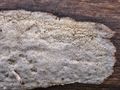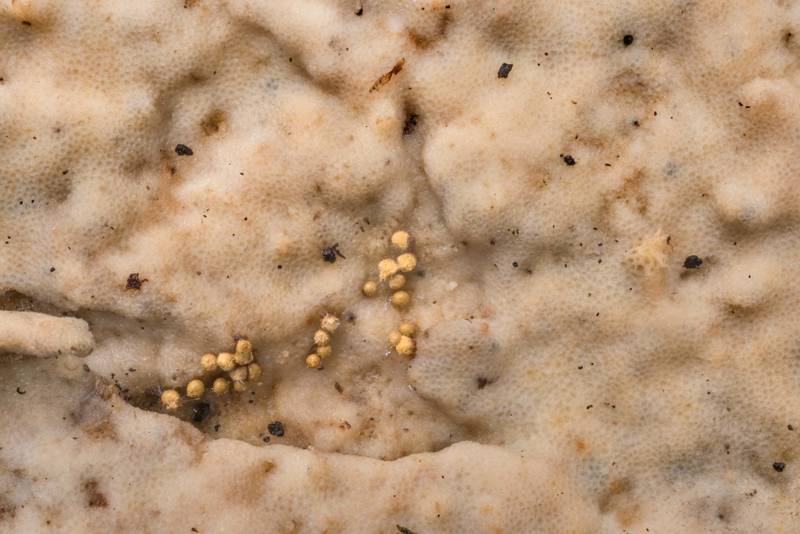

Close-up of white resupinate polypore mushroom "boring poria" (Oxyporus corticola)(?) on a fallen tree without bark near Dibuny, north-west from St.Petersburg, Russia


Album 2923: Dibuny near St. Petersburg, Russia, May 5, 2021
The image shows a close-up view of a white resupinate polypore growing on a fallen tree branch devoid of bark. The fungus is characterized by its unique growth habit, with the hymenium (the layer containing spore-bearing cells) exposed to the air and arranged in an overlapping manner, often resembling scales or plates. This type of growth pattern is typical for resupinate polypores.
**Key Features:**
* **Fungal Growth:** The fungus has a white, irregularly shaped body with a thin, membranous texture. It appears to be growing on the surface of the tree branch.
* **Spore Discharge:** Small clusters of spores are visible near the center of the image, indicating that the fungus is actively producing and releasing its reproductive structures.
* **Tree Branch:** The fallen tree branch provides a natural substrate for the fungus to grow on. Its absence of bark suggests that it may have been weathered or damaged in some way.
**Conclusion:**
The image provides a detailed view of a white resupinate polypore growing on a fallen tree branch without bark. The fungus's unique growth pattern and spore discharge are clearly visible, offering insights into its biology and ecology. – AI vision
🇷🇺 Описание по-русски / Russian Description
На снимке изображен крупным планом белый ресупинатный полипоровый гриб на вале без коры недалеко от Дибунь, северо-запад Санкт-Петербурга, Россия, 5 мая 2021 года. На изображении приведено крупное плановое изображение белого ресупинатного полипорового гриба, растущего на ветке вала без коры. Гриб характеризуется уникальной формой роста с гимением (слоем, содержащим спор), выставленным наружу и расположенным чередующимися, часто напоминающий чешуи или пластины. Эта модель роста типична для ресупинатных полипоровых грибов. **Основные черты:** * **Развитие гриба:** Гриб имеет белый, неправильной формы орган с тонкой, мембранной текстурой. Он растет на поверхности ветки дерева. * **Рассеивание спор:** Мелкие скопления спор видны возле центра изображения, что указывает на активное производство и высвобождение репродуктивных структур гриба. * **Ветка дерева:** Вал без коры служит естественным субстратом для развития гриба. Отсутствие коры указывает на то, что она, возможно, пострадала от непогоды или повреждений. * **Заключение:** На изображении представлено подробное изображение белого ресупинатного полипорового гриба, растущего на вале без коры. Уникальная форма роста и рассеивание спор хорошо видны, что позволяет лучше понять биологию и экологию данного организма. – Russian translation