
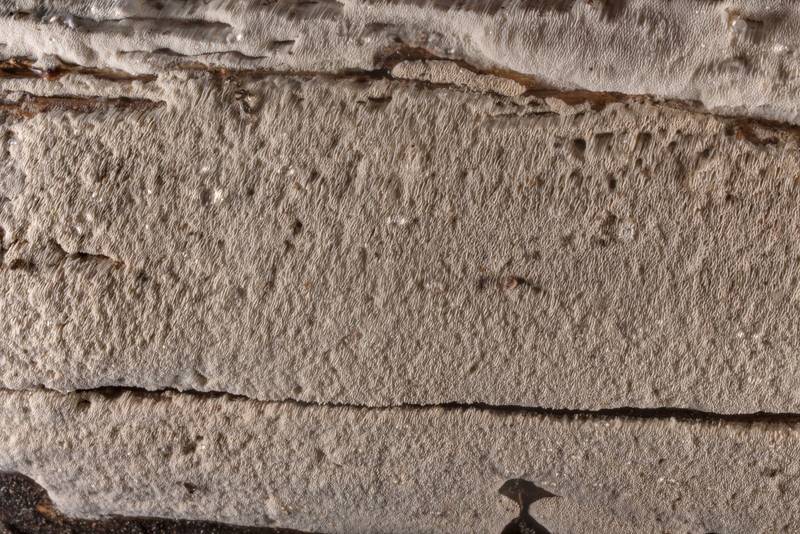

Texture of resupinate polypore mushroom Sidera lenis (Skeletocutis lenis)(?) on a fallen pine in wet area in Sosnovka Park. St.Petersburg, Russia


Album 2927: St. Petersburg, Russia, May 8, 2021
The image presents an up-close view of a fungus growing on a fallen tree trunk. The texture of the tree is characterized by a rough and uneven surface, with visible cracks and ridges. This suggests that the tree has been exposed to various environmental factors over time, resulting in its current state.
The fungus itself appears as a white, powdery substance covering a significant portion of the tree's surface. Its texture is soft and irregular, resembling a thin layer of moss or lichen. The fungus seems to be growing in a random pattern, with no discernible shape or structure.
In the background, the fallen tree trunk provides a natural context for the fungus to grow. The surrounding environment appears to be a forested area, possibly a park or nature reserve, given the mention of Sosnovka Park in the caption. The presence of other trees and foliage can be inferred from the subtle shadows and reflections visible on the surface of the tree.
Overall, the image captures a moment in time when nature is reclaiming a fallen tree as part of its ecosystem. The fungus plays a crucial role in breaking down organic matter and recycling nutrients, highlighting the interconnectedness of living organisms in an environment. – AI vision
🇷🇺 Описание по-русски / Russian Description
Текстура перистых наростей гриба Sidera lenis (Skeletocutis lenis)(?) на поваленной сосне в увлажненном месте в парке Сосновока. Санкт-Петербург, Россия, 8 мая 2021 года. На изображении видна детальная структура грибка, растущего на поваленном стволе дерева. Текстура древесины характеризуется неровной и шероховатой поверхностью с видимыми трещинами и ребрами. Это говорит о том, что со временем дерево подвергалось воздействию различных природных факторов, из-за чего пришло в нынешнее состояние. Сам грибок выглядит как белый порошок, покрывающий значительную часть поверхности дерева. Его текстура мягкая и нерегулярная, напоминающая тонкий слой мха или лишайника. Грибок растет хаотично, без какой-либо определенной формы или структуры. На заднем плане поваленный ствол дерева создает естественное окружение для роста грибка. Соседствующая среда, вероятно, представляет собой лесной массив, возможно, парк или природный заповедник, учитывая упоминание о парке Сосновока в подписи к изображению. Наличие других деревьев и растительности можно сделать вывод по тонким тени и отражениям на поверхности дерева. В целом, изображение запечатлело момент времени, когда природа образует пленку на поваленном дереве как часть экосистемы. Грибок играет решающую роль в расщеплении органического вещества и переработке питательных веществ, подчеркивая взаимосвязь живых организмов с окружающей средой. – Russian translation


