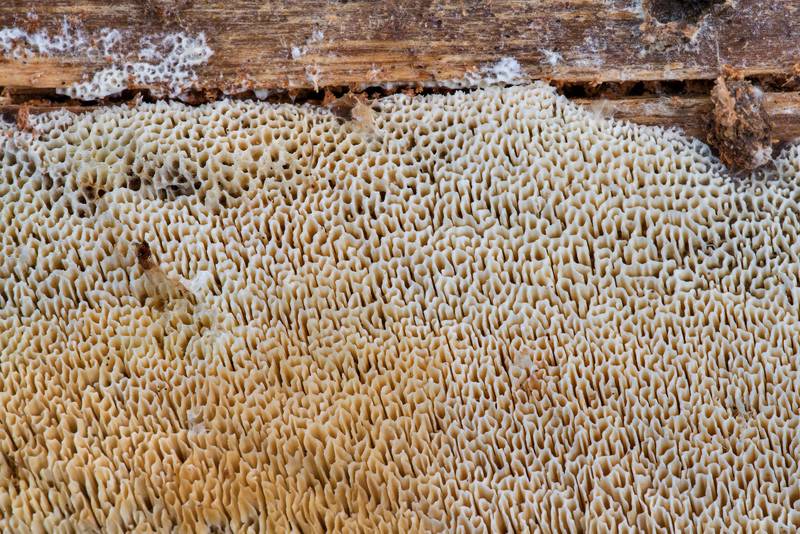

Margin of resupinate polypore mushroom covering large area on a fallen spruce in Zakhodskoe (Lounatjoki), 50 miles north from St.Petersburg. Russia


Album 2933: Morye - Zakhodskoe near St. Petersburg, Russia, May 13 - 15, 2021
The image presents a close-up view of a resupinate polypore mushroom covering a large area on a fallen spruce tree trunk. The mushroom's white to light brownish coloration is striking against the dark brown background of the wood.
**Key Features:**
* **Resupinate Polypore Mushroom:** The image showcases a significant portion of the mushroom, characterized by its resupinate growth form, which means it grows on or under the surface of another organism. In this case, it covers a substantial area on the fallen spruce trunk.
* **Coloration:** The mushroom exhibits a uniform white to light brownish coloration across its entire surface. This color pattern is typical for many polypore species and may serve as an adaptation for various ecological functions such as attracting insects or decomposing organic matter.
* **Texture and Structure:** Upon closer inspection, the texture of the mushroom appears irregular with numerous tiny pores visible on its underside. These pores are a common feature among polypores, contributing to their role in breaking down dead wood and facilitating nutrient cycling within ecosystems.
* **Environmental Context:** The image was captured near Saint Petersburg, Russia, suggesting that the environment is likely temperate or boreal forested areas dominated by spruce trees (Picea spp.). The season of observation is early spring, indicated by the presence of a small amount of snow visible in the upper right corner of the image. This timing could influence the growth patterns and development stages of the polypore mushroom.
* **Mycological Significance:** Polypores are an important part of forest ecosystems worldwide due to their role in decomposing dead wood, thereby recycling nutrients back into the environment. They also provide habitat for various insects and other organisms, contributing to biodiversity within these ecosystems.
In summary, the image provides a detailed view of a resupinate polypore mushroom covering a large area on a fallen spruce tree trunk, highlighting its unique growth form, coloration, texture, and structural features that are typical of this type of fungus. The environmental context suggests a temperate or boreal forest setting in early spring, underscoring the ecological significance of such organisms in maintaining ecosystem balance and promoting biodiversity. – AI vision
🇷🇺 Описание по-русски / Russian Description
На этой фотографии изображена подробная детальность древесной шляпки розового коровийяка, покрывающего большую площадь на вале сфрагиовыми иголками в Заходске (Луонайоки), в 50 милях к северу от Санкт-Петербурга. Россия, 15 мая 2021 года. На изображении присутствует детальный план древесной шляпки розового коровийяка, покрывающего большую площадь на вале сфрагиовыми иголками. Бело- светло-коричневая окраска гриба выделяется на темно-буком фоне древесины. **Ключевые особенности:** * **Древесная шляпка розового коровийяка:** На фотографии представлена значительная часть гриба, характеризующаяся его формой роста на поверхности или под ней другого организма. В данном случае он покрывает большую площадь ствола вале сфрагиовыми иголками. * **Окраска:** Гриб отображает равномерную бело-светло-коричневую окраску на всей своей поверхности. Такая цветовая палитра характерна для многих видов полипоров и может служить адаптацией для различных экологических функций, таких как привлечение насекомых или разложение органического вещества. * **Текстура и структура:** При ближайшем рассмотрении текстура гриба кажется нерегулярной с многочисленными мелкими порами, видимыми на его нижней стороне. Эти поры являются обычным признаком полипоров, внося свой вклад в их роль в расщеплении мертвого дерева и содействии циркуляции питательных веществ в экосистемах. * **Экологический контекст:** Фотография была сделана недалеко от Санкт-Петербурга, Россия, предполагая, что окружающая среда является умеренным или boreal лесами, занятыми елями (Picea spp.). Время наблюдения ранней весной отмечено присутствием небольшого количества видимого снега в верхнем правом углу изображения. Это время может повлиять на модели роста и стадии развития гриба. * **Микологическое значение:** Полипоры являются важной частью экосистем лесов по всему миру в связи с их ролью в расщеплении мертвого дерева, таким образом, перераспределяя питательные вещества обратно в окружающую среду. Они также обеспечивают среду обитания для различных насекомых и других организмов, способствуя биоразнообразию в этих экосистемах. В общем, фотография показывает детальный план древесной шляпки розового коровийяка, покрывающей большую площадь на вале сфрагиовыми иголками, подчеркивая его уникальную форму роста, окраску, текстуру и структуру, типичные для этого гриба. Экологический контекст предполагает умеренный или boreal леса в раннюю весну, подчеркивая экологическое значение таких организмов в поддержании баланса экосистем и продвижению биоразнообразия. – Russian translation