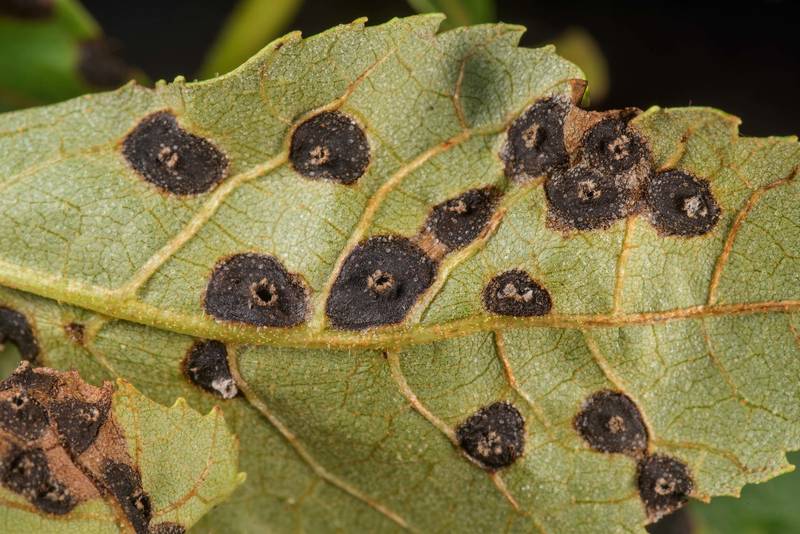

Leaves of hickory with black spots and holes caused by insects(?) on Richards Loop Trail in Sam Houston National Forest. Texas


Album 2951: Sam Houston Forest, Texas, June 2, 2021
The image depicts a close-up view of hickory leaves with distinctive black spots and holes. The leaves are greenish-brown with serrated edges, characteristic of hickory trees (Carya spp.). The black spots, which appear to be circular or oval in shape, cover the surface of the leaf. They vary in size, ranging from small to medium-sized.
Upon closer inspection, it becomes apparent that these black spots are not caused by insects but rather by a fungal infection known as tar spot disease (Rhytisma acerinum). This disease is common in hickory trees and other deciduous species, particularly during the spring and summer months when temperatures are warm and humid.
The tar spot fungus produces spores that infect the leaves of the tree, causing them to turn yellow or brown before developing black spots. These spots can become large enough to cover most of the leaf surface, leading to defoliation if left unchecked.
In addition to the black spots, some leaves exhibit holes at their tips or along the margins. While these holes could be caused by insects such as caterpillars or sawflies, it is more likely that they are also a result of tar spot disease. The fungus can weaken the leaf tissue, making it susceptible to damage from environmental factors like wind or rain.
Overall, the image suggests that the hickory tree on Richards Loop Trail in Sam Houston National Forest is experiencing an outbreak of tar spot disease. This condition can have significant impacts on tree health and productivity if left unmanaged. – AI vision
🇪🇸 Descripción en español / Spanish Description
Hojas de higuera de castaño con manchas negras y agujeros causados por insectos en el Richards Loop Trail en la Sam Houston National Forest. Texas, 2 de junio de 2021. La imagen representa una vista cercana a las hojas de higuera de castaño con manchas negras distintivas y agujeros. Las hojas son marrones parduscas con bordes dentados, característicos de los árboles de higuera de castaño (Carya spp.). Las manchas negras, que parecen ser circulares u ovaladas en forma, cubren la superficie de las hojas. Variar en tamaño, van desde pequeñas a de tamaño mediano. Al examinarlos más de cerca, se vuelve aparente que estas manchas negras no son causadas por insectos sino por una infección fúngica conocida como mancha de alquitrán (Rhytisma acerinum). Esta enfermedad es común en higuera de castaño y otras especies caducifolias, particularmente durante los meses de primavera y verano cuando las temperaturas son cálidas y húmedas. El hongo del alquitrán produce esporas que infectan las hojas del árbol, lo que hace que se vuelvan amarillas o marrones antes de desarrollar manchas negras. Estas manchas pueden llegar a ser lo suficientemente grandes como para cubrir la mayor parte de la superficie de las hojas, conduciendo a la defoliación si no se controla. Además de las manchas negras, algunas hojas presentan agujeros en sus puntas o a lo largo de los márgenes. Mientras que estos agujeros podrían ser causados por insectos como orugas o moscas de sierra, es más probable que también sean el resultado de la infección por mancha de alquitrán. El hongo puede debilitar el tejido foliar, haciéndolo susceptible a daños provocados por factores ambientales como viento o lluvia. En general, la imagen sugiere que el árbol de higuera de castaño en el Richards Loop Trail en Sam Houston National Forest está experimentando un brote de mancha de alquitrán. Esta afección puede tener impactos significativos en la salud y productividad del árbol si no se gestiona. – Spanish translation