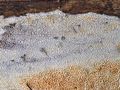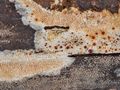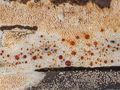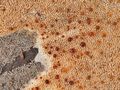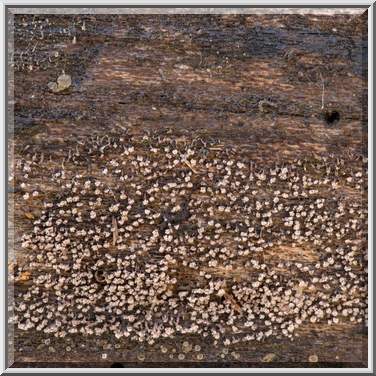
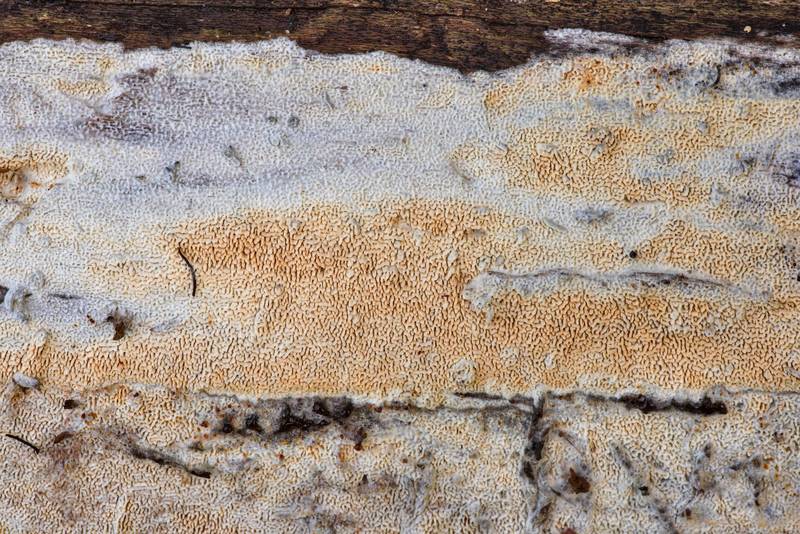
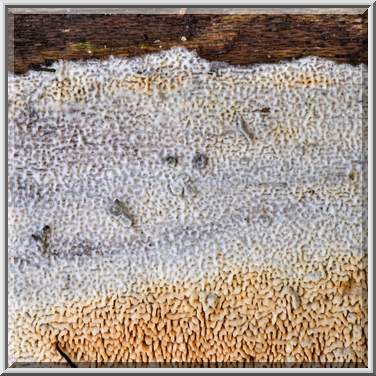
Some hydnoid corticioid mushroom on a fallen oak in Washington-on-the-Brazos State Historic Site. Washington, Texas


Album 2958: Mushrooms in Washington-on-the-Brazos, Texas, June 6, 2021
The image shows an up-close view of a fungal organism growing on or within a fallen tree trunk (likely an oak). The fungus is characterized by its small, tooth-like projections called "hyphal tips" that are visible as short, thin spikes protruding from the surface.
**Fungal Growth**
* The fungus has grown in layers, with each layer featuring slightly different shades of color.
* The topmost layer is white or light gray and appears to be a thick crust.
* Beneath this layer, there are several other layers that are lighter in color than the one above them.
* The bottom-most layer is darker brown and seems to have some sort of structure or texture.
**Tree Trunk**
* The fallen tree trunk has dark brown bark with deep grooves and ridges that provide a rough surface for the fungus to grow on.
* The wood grain is visible through the gaps between the fungal growth, indicating that it has partially colonized the tree's interior.
**Overall Appearance**
The image suggests that this fungal organism is in its early stages of development and is still growing rapidly. Over time, as more layers form and the fungus continues to spread, its appearance may change significantly, potentially becoming more intricate or complex. – AI vision
🇪🇸 Descripción en español / Spanish Description
Algunos hongos corticoides hidnoides en un roble caído en el sitio histórico estatal de Washington-on-the-Brazos. Washington, Texas, 6 de junio de 2021. La imagen muestra una vista detallada de un organismo fúngico que crece sobre o dentro de un tronco de árbol caído (probablemente un roble). El hongo se caracteriza por sus pequeñas proyecciones dentadas llamadas "puntas de hifa" que son visibles como picos cortos y delgados que sobresalen de la superficie. **Crecimiento fúngico** * El hongo ha crecido en capas, con cada capa presentando tonalidades ligeramente diferentes. * La capa más superior es blanca o gris claro y parece ser una costra gruesa. * Bajo esta capa, existen otras capas que son de color más ligero que la anterior. * La capa inferior es marrón oscuro y parece tener algún tipo de estructura o textura. **Tronco del árbol** * El tronco del árbol caído tiene corteza marrón oscura con surcos y arrugas profundos que proporcionan una superficie rugosa para el crecimiento fúngico. * Se puede observar la textura de la madera a través de los huecos entre el crecimiento fúngico, lo que indica que ha colonizado parcialmente el interior del árbol. **Aspecto general** La imagen sugiere que este organismo fúngico está en sus primeras etapas de desarrollo y todavía está creciendo rápidamente. Con el tiempo, a medida que se forman más capas y el hongo continúa expandiéndose, su apariencia puede cambiar significativamente, potencialmente volviéndose más intrincado o complejo. – Spanish translation