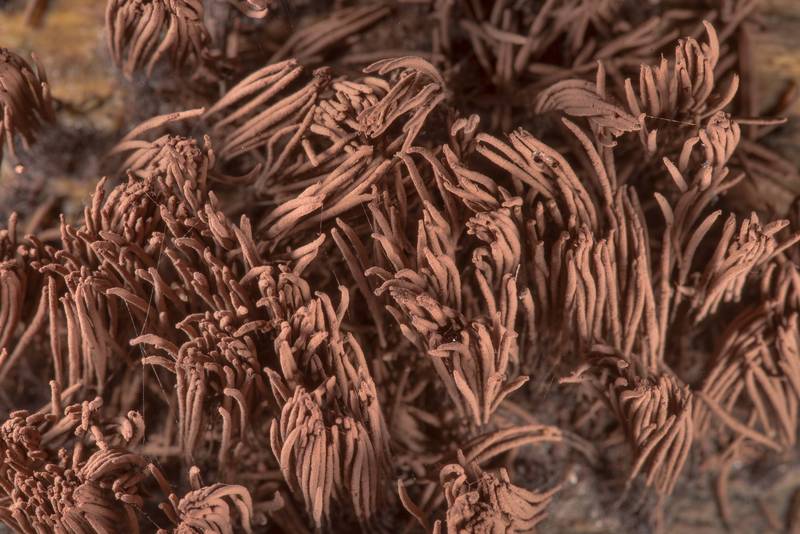

Masses of sporangia of slime mold Stemonitis fusca on a pine log on Caney Creek Trail (Little Lake Creek Loop Trail) in Sam Houston National Forest north from Montgomery. Texas


Album 2964: Sam Houston Forest, Texas, June 13, 2021
The image shows a large cluster of brownish-red sporangia, which are likely part of a slime mold called Stemonitis fusca. The sporangia appear to be growing on a pine log and have an elongated shape with pointed tips. They are clustered together in masses, indicating that they are part of the same colony.
The background of the image is blurry, but it appears to be a forest floor or trail surface, possibly covered in leaves or other debris. The overall atmosphere of the image suggests a damp and humid environment, which is consistent with the habitat preferences of slime molds like Stemonitis fusca.
Based on this description, we can infer that the image was taken in a natural setting, likely in a forest or woodland area, where the photographer encountered the slime mold growing on a pine log. The time of year when the photo was taken is not explicitly stated, but given the presence of sporangia, it is likely that the image was captured during the summer months when slime molds are most active.
Overall, the image provides valuable information about the morphology and habitat of Stemonitis fusca, a species of slime mold that is relatively understudied. – AI vision
🇪🇸 Descripción en español / Spanish Description
Masas de esporangios del moho del limo Stemonitis fusca en un tronco de pino en el Caney Creek Trail (Little Lake Creek Loop Trail) en la Sam Houston National Forest al norte de Montgomery, Texas, el 13 de junio de 2021. La imagen muestra una gran agrupación de esporangios marronáceos rojizos, que probablemente forman parte de un moho del limo llamado Stemonitis fusca. Los esporangios parecen estar creciendo en un tronco de pino y tienen una forma alargada con puntas agudas. Están agrupados en masas, lo que indica que forman parte de la misma colonia. El fondo de la imagen está borroso, pero parece ser el suelo del bosque o la superficie del sendero, posiblemente cubierta de hojas u otros restos. La atmósfera general de la imagen sugiere un entorno húmedo y húmedo, lo que es consistente con los hábitats preferidos de los mohos del limo como Stemonitis fusca. Con base en esta descripción, podemos inferir que la imagen fue tomada en un entorno natural, probablemente en un bosque o área boscosa, donde el fotógrafo encontró el moho del limo creciendo en un tronco de pino. El tiempo del año cuando se tomó la foto no está explícitamente establecido, pero dada la presencia de esporangios, es probable que la imagen se haya capturado durante los meses de verano cuando los mohos del limo son más activos. En general, la imagen proporciona información valiosa sobre la morfología y el hábitat de Stemonitis fusca, una especie de moho del limo que está relativamente poco estudiada. – Spanish translation